Stranded on Purpose: The Era When Flying Coast to Coast Meant Sleeping in a City You Never Planned to Visit
Imagine booking a flight from New York to Los Angeles and being told, completely matter-of-factly, that you'll be spending Tuesday night in Kansas City. Not because something went wrong. Not because of weather or a mechanical issue. Just because that's how flying worked.
 Photo: Kansas City, via c8.alamy.com
For a significant stretch of American aviation history, that was the deal. You bought a ticket, you packed a bag, and somewhere in the middle of the country, you got off the plane, checked into a hotel, and waited for tomorrow's leg to depart. The journey was the journey — all of it, including the parts that happened on the ground in cities you'd never thought about visiting.
The Range Problem Nobody Talks About Anymore
Early commercial aircraft simply couldn't fly coast to coast without stopping. The planes of the 1930s and 1940s — the Douglas DC-3s that defined an era — had a range of roughly 1,500 miles under ideal conditions. New York to Los Angeles is about 2,800 miles. The math didn't work, and nobody pretended it did.
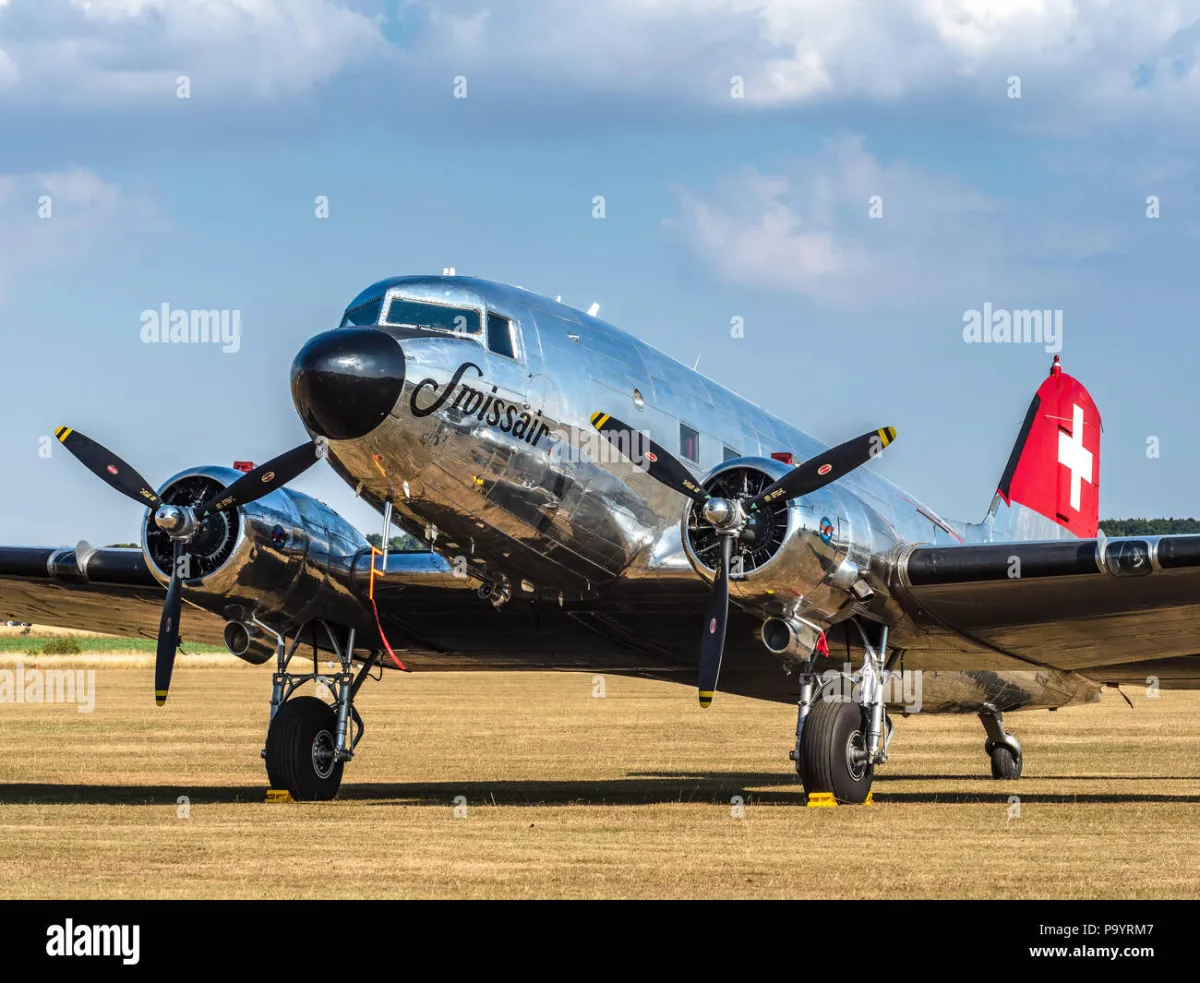 Photo: Douglas DC-3, via c8.alamy.com
So airlines built routes the way railroads had before them: in segments. Transcontinental passengers might touch down in Chicago, then Kansas City, then Albuquerque, then finally Los Angeles — each stop a brief refueling pause or, if the schedule demanded it, an overnight stay. Airlines actually coordinated with hotel chains to provide accommodations, and the overnight stop was treated not as an inconvenience but as a feature. You were flying. That was remarkable enough. A night in a nice hotel along the way seemed like a reasonable part of the bargain.
By the early 1950s, aircraft like the Lockheed Constellation and later the Boeing 707 pushed ranges further, but scheduled overnight stops persisted well into the jet age for certain routes — partly out of operational habit, partly because crews needed rest, and partly because the infrastructure of American aviation had been built around the assumption that nobody was going anywhere in a single day.
What Happened During Those Unplanned Nights
Here's the part that gets genuinely interesting: people made the most of it.
Travelers in the mid-century era didn't treat an overnight layover as dead time to be survived. They explored. They ate at local restaurants, wandered downtown streets, struck up conversations with locals who were curious about these well-dressed people passing through on their way somewhere else. A businessman flying from Boston to San Francisco might find himself having dinner in Denver with a couple he'd met in the airline's hotel lobby, swapping stories about where they were headed and why.
Airlines leaned into this. Some marketed their layover cities as part of the experience. Promotional materials from the late 1940s occasionally highlighted the overnight stop as a chance to "discover the heart of America" — which was partly genuine and partly a way of reframing an operational limitation as a selling point. Either way, it worked on some level. Passengers arrived at their final destinations having seen more of the country than they'd planned.
There was also something democratizing about it. Everyone was in the same situation. The executive and the schoolteacher were both standing in the same hotel lobby in Memphis at 9 p.m., both equally stranded, both equally required to figure out dinner.
The Hub-and-Spoke Revolution Changed Everything
As aircraft range extended and deregulation reshaped the airline industry in the late 1970s, the enforced overnight layover faded fast. Hub-and-spoke routing — where airlines funneled passengers through major connection cities like Atlanta, Chicago, and Dallas — made transcontinental travel dramatically more efficient. Nonstop flights between major cities became standard. The idea of spending a night somewhere because the plane couldn't go any further started to sound like a story your grandfather would tell.
By the 1990s, the overnight stop was essentially gone from domestic travel. What replaced it was the modern layover: a frantic 45-minute sprint through a terminal, a mediocre airport sandwich, and the particular anxiety of watching your connection gate change twice before boarding.
We got faster. We got more efficient. We did not, by any reasonable measure, get more interesting.
The Sterile Miracle of Nonstop Travel
There's no serious argument for going back. Nonstop flights are genuinely better by almost every practical measure. They're faster, cheaper in aggregate, and far less exhausting. Nobody who needs to get somewhere for a funeral or a job interview or a family emergency wants to spend Tuesday night in Kansas City.
But something real was lost in the transition, and it's worth naming it.
The enforced pause of a mid-century layover created encounters that modern travel has systematically eliminated. It put people in unfamiliar places without a plan, which is often exactly when the most memorable things happen. It made the journey itself an experience rather than an obstacle. And it gave travelers an accidental familiarity with the American interior — the cities between the coasts that most people now fly over at 35,000 feet without a second thought.
Today, if you want to experience Memphis or Albuquerque or Kansas City, you have to choose to go there. You have to plan it, book it, and commit to it. The era of being gently deposited in an unexpected place by the limitations of early aviation is over.
Which is probably fine. But the next time you're somewhere between takeoff and landing, staring at the flight tracker showing two hours and forty minutes to Los Angeles, it's worth remembering that for a long time, this was a two-day trip — and the extra day sometimes turned out to be the best part.