The Little Blue Book That Could Take Six Months to Arrive — And Ruin Your Entire Vacation
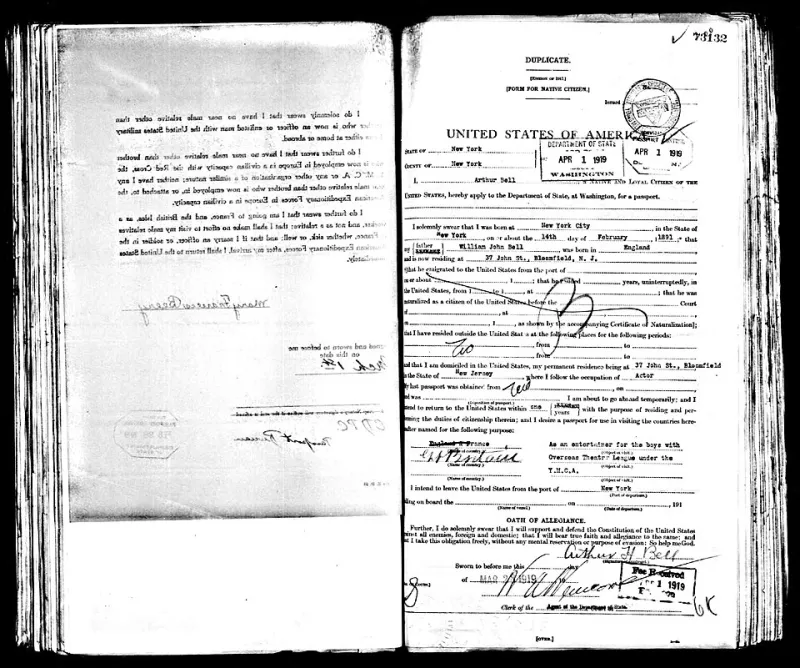
Photo: AnonymousUnknown author, Public domain, via Wikimedia Commons
Imagine planning a trip to Europe. You pick the dates, research the flights, start dreaming about the food. Then someone reminds you that you need a passport — and you realize that getting one might take longer than the trip itself.
That wasn't a hypothetical for Americans in the 1970s, 1980s, or even well into the 1990s. It was the reality of international travel planning. The passport wasn't just documentation. It was a bureaucratic obstacle course that filtered out anyone without the patience, foresight, and organizational discipline to navigate a system that seemed specifically designed to discourage people from leaving the country.
Mailing Your Life Into a Void
The process started with your birth certificate. Not a photocopy — your original. The government required it to verify citizenship, which meant you had to locate it, which for many Americans meant a panicked search through filing cabinets, shoeboxes, and the back of closets. If you couldn't find it, you had to request a certified copy from the state where you were born, which could take weeks on its own.
Once you had everything assembled — birth certificate, two passport photos taken at a specific size by a specific method, a completed application form, and a check for the fee — you mailed it all to a regional passport agency and waited. The whole package, including documents you couldn't replace, disappeared into the postal system and the federal bureaucracy simultaneously.
Processing times in the peak of the 1980s and early 1990s could stretch to four to six months during busy periods. If you had a trip booked and your passport didn't arrive in time, there was essentially nothing you could do. You couldn't track the application. You couldn't easily call someone. You could write a letter, which would enter the same void your application had already vanished into.
Losing the application entirely wasn't unheard of. Losing the original birth certificate along with it was a nightmare scenario that actually happened to real people — people who then had to spend months reconstructing documentation they'd held for decades.
The Expedited Option That Wasn't Really an Option
There was technically a way to get a passport faster. You could appear in person at one of the handful of regional passport agencies — located in major cities like New York, Chicago, Los Angeles, and a few others — and apply for expedited processing. This required proof of imminent international travel, meaning a flight booked within two weeks.
 Photo: New York, via www.metrc.com
The catch was obvious. To get a passport quickly, you needed to already have a flight booked. To book a flight confidently, you needed a passport. The system trapped people in a circular logic that made spontaneous international travel essentially impossible for anyone who wasn't already a frequent traveler with a valid passport on hand.
And even the in-person option wasn't simple. Regional offices operated on limited hours, required appointments that were themselves hard to secure, and often had lines stretching out the door and down the block. Taking a day off work to stand in line at a federal building in a city you didn't live in was the price of last-minute international travel.
The Transformation Nobody Fully Noticed
The modernization of U.S. passport processing happened gradually, driven partly by technology and partly by the surge in international travel demand that followed the spread of affordable air travel.
The most significant single change came after September 11, 2001 — and it came from an unexpected direction. The Western Hemisphere Travel Initiative, implemented in 2007, required Americans to present a passport when returning from Canada, Mexico, and the Caribbean for the first time. Before that, a driver's license was sufficient for much of North American travel. The new requirement triggered a massive surge in passport applications — and a corresponding crisis in processing capacity.
Wait times ballooned to four months or more. The State Department was overwhelmed. The crisis forced a serious rethinking of the entire system, leading to investments in processing capacity, staffing, and eventually technology that began to streamline the experience.
Digital photography standards replaced the rigid requirements for physical photos. Online application tracking let applicants actually see where their paperwork was in the process. Expedited processing became more reliably available, and the definition of "expedited" shrank from weeks to days. Electronic passport chips made the documents themselves more secure and more universally accepted.
The most recent development — online passport renewal for eligible adults — represents the most dramatic shift of all. Americans who already hold a valid or recently expired passport can now renew entirely online, without mailing original documents anywhere, without visiting a government office, and without the particular anxiety of watching irreplaceable paperwork disappear into the mail.
What International Travel Actually Used to Cost
The passport ordeal wasn't just an inconvenience. It had real economic and cultural consequences. International travel required so much advance planning — and carried so much risk of bureaucratic failure — that it remained the domain of people with significant resources, flexibility, and experience.
Business travelers, wealthy families, and academics who needed international access built the planning time into their routines. Everyone else treated international travel as a major life event requiring months of preparation, not a weekend trip to Mexico or a last-minute deal to London.
The ripple effects shaped American culture in ways that are hard to measure. The United States has historically had lower passport ownership rates than comparable wealthy nations. As recently as 2007, fewer than 30 percent of Americans held valid passports. That number has climbed steadily since — driven partly by the post-2007 travel requirements and partly by the simple fact that getting a passport became dramatically less painful.
Today, roughly half of all Americans hold a valid passport. Processing times for standard applications run six to eight weeks. Expedited options bring that down to two to three weeks. Online renewal, when fully rolled out, could reduce the friction further still.
The Errand That Replaced the Ordeal
None of this means the process is perfect. Passport agencies still get overwhelmed during peak periods. Processing times still fluctuate. The system still occasionally loses documents and sends applicants into bureaucratic limbo.
But the baseline experience has transformed beyond recognition. What once required months of planning, a leap of faith with irreplaceable documents, and a genuine risk of having your travel plans collapse entirely has become, for most Americans, something closer to a manageable task on a to-do list.
Your grandparents didn't go to Europe on a whim. The paperwork alone would have stopped them. That's not a small thing — it's the difference between a world that felt accessible and one that felt like it required a formal application just to visit.
We don't think much about the little blue book until we need it. But the story of how it got easier to get is, quietly, a story about how the world got a little more open.