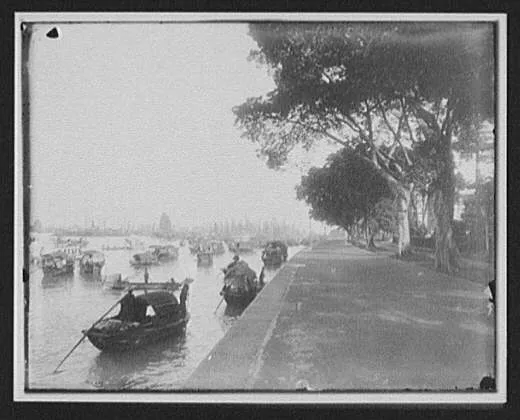
Photo: William Henry Jackson, Public domain, via Wikimedia Commons
Here's a fact that should stop you mid-scroll: for most of human history, the word 'commute' meant nothing, because almost nobody traveled to work at all. You worked where you lived — on the farm, above the shop, behind the house. The idea of traveling a significant distance every single day just to earn wages is barely two centuries old.
Since then, the journey to work has been reinvented at least five times. Let's walk through them, because each era's commute would look absurd to the people on either side of it.
Era 1: The Walker's Commute (Pre-1850s)
When early factories pulled workers into growing cities, most people got there the way humans had always gotten everywhere: on foot. Workers in mill towns like Lowell, Massachusetts, routinely walked an hour or more each way — two-plus hours of daily walking on top of a 12-hour shift.
This set the geometry of the industrial city: housing packed tight around the workplace because distance was paid for in shoe leather. The 19th-century commute wasn't miserable because it was slow. It was miserable because it was voluntary-looking but wasn't — you walked because the alternative was not eating.
Era 2: The Streetcar and the Birth of the Suburb (1850s–1900s)
The horse-drawn streetcar, then the cable car, then the electric trolley rewrote the rules. Suddenly a person could live miles from work and still arrive on time. The 'streetcar suburb' was born — places like the outer neighborhoods of Chicago and Cleveland exist in their exact shape because of trolley lines.
The word 'commute' itself comes from this era: railroad companies 'commuted' (reduced) workers' fares for regular seasonal tickets. The commute became a thing you purchased, which made it a thing you could complain about. The modern grievance was born right on schedule.
Era 3: The Subway Squeeze (1900s–1950s)
Underground rail supercharged the streetcar effect. New York's subway system, opened in 1904, let the city sprawl into Brooklyn, Queens, and the Bronx, and it packed commuters in at densities that would be considered a safety violation today. Photographs from the 1910s show platforms so crowded that conductors literally pushed passengers aboard.
But here's the surprising part: this was, by the numbers, the fastest the average commute has ever been. Dense housing near dense transit meant short, reliable trips. The average commute time in early 20th-century cities was often under 30 minutes — better than many American metro areas manage in 2024.
Era 4: The Interstate and the Solo Driver (1956–2020)
Then America made a bet. The Federal-Aid Highway Act of 1956 — and the subsidized gasoline, free parking, and cheap tract housing that came with it — rebuilt the country around the car. Commuting went from a shared ride on rails to a private experience in a two-ton vehicle, often alone.
The results were paradoxical. Cars freed workers from timetables and gave them climate control, radios, and privacy. But they also ate space: a subway car moving 40 mph carries more people than a mile of bumper-to-bumper freeway. Average commutes stretched past 27 minutes each way by century's end, and 'traffic' became a word loaded with a rage the trolley platforms never quite matched.
Era 5: The Commute That Wasn't (2020–Now)
Then, in March 2020, the commute simply stopped. Within weeks, tens of millions of American workers discovered that the journey to work was, for many jobs, a convention rather than a necessity. The average commute had consumed roughly 200 hours of every worker's year — and suddenly that time was returned.
And yet. Here's the twist nobody predicted: the commute didn't die. It mutated. Hybrid schedules turned Tuesday-through-Thursday into traffic days while Monday and Friday freeways run empty. Workers without hybrid options saw return-to-office mandates claw back the hours. And some people, research suggests, actually miss parts of the commute — the decompression, the transition between work-self and home-self, the audiobook hour.
So Did It Get Better?
Measured in minutes, the modern American commute is roughly twice as long as the streetcar-era commute. Measured in comfort, it's a spa treatment: your 1915 counterpart was being crushed against a stranger in an unheated rail car.
What's really changed is what the commute costs and what it buys. It used to buy distance from the smoke of the factory; now it buys a house with a yard and a school district. The commute hasn't improved so much as it has been renegotiated, era after era, between what technology makes possible and what we're willing to trade for it. Right now, we're in the middle of the biggest renegotiation in a century — and nobody, including the people living it, knows what the next era looks like.