You Used to Know Where You Were. Now You Just Follow the Arrow.
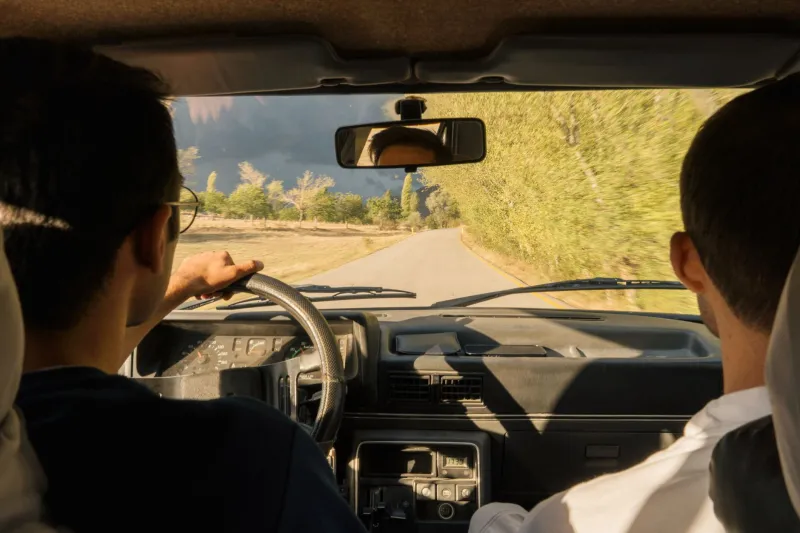
There's a particular kind of panic that hits modern travelers when their phone signal disappears. Not inconvenience — actual panic. A blank screen where the blue dot used to be. No arrow. No voice. No idea which way is north. It's the kind of helplessness that would have seemed completely alien to someone driving across the country in 1987.
Because back then, knowing where you were wasn't optional. It was just something you did.
The Atlas Was a Serious Object
Every American car worth anything had a road atlas in the back seat or stuffed under the passenger seat, its spine cracked from years of being opened at awkward angles. Rand McNally published new editions annually, and families actually bought them. Not as novelties. As tools.
Planning a road trip meant sitting at the kitchen table the night before, tracing a route with a finger, writing down exit numbers on a notepad, and memorizing the general shape of where you were going. You built a mental model of the journey — not turn-by-turn, but conceptually. You knew you were heading southeast for about four hours, that you'd pass through a mid-sized city around the halfway mark, and that you'd need to watch for a fork somewhere near the state line.
That mental model was load-bearing. If something went wrong — road closed, detour, missed exit — you had enough internal geography to improvise. You could reason your way back onto the right path.
Today, most people couldn't tell you which direction they drove to work this morning.
Asking for Directions Was a Social Transaction
When you got lost — and everyone got lost — you stopped and asked. This sounds simple, but it involved a whole set of skills that have nearly vanished. You had to approach a stranger, explain your situation clearly, listen carefully to instructions that often came in the form of landmarks rather than street names, and then hold those instructions in your head long enough to act on them.
Turn left at the old Sears. Go past the water tower. When you see the Dairy Queen, you've gone too far.
Directions used to be embedded in local knowledge. The person giving them knew the area the way they knew their own neighborhood, and they communicated it in human terms — not coordinates. And you, the receiver, had to pay attention. There was no fallback.
This created something interesting: people actually knew their communities spatially. They understood how streets connected, which roads ran parallel, where the shortcuts were. That knowledge was earned through years of navigating without assistance.
What the GPS Actually Did to Us
When navigation apps arrived — MapQuest first, then Google Maps, then Waze — they didn't just make getting around easier. They fundamentally changed the cognitive relationship between a person and their physical environment.
Neuroscientists have studied this. Research out of University College London found that when people rely heavily on GPS navigation, the hippocampus — the brain region responsible for spatial memory — shows reduced engagement. In other words, when you outsource navigation, your brain stops doing the work it once did automatically. Use it or lose it applies to gray matter just as much as muscle.
The practical result is a generation of adults who can navigate to any address on earth but couldn't tell you, without checking their phone, which direction downtown is from where they're standing right now.
The Trade-Off Nobody Voted On
Here's the honest part: GPS is extraordinary. It has saved lives, reduced traffic deaths caused by distracted map-reading, made traveling in unfamiliar cities genuinely accessible, and helped people with certain cognitive and anxiety disorders participate in the world more freely. The efficiency gains are real and significant.
But we didn't consciously decide to trade away spatial literacy for convenience. It just happened, gradually, as the technology became ubiquitous. Each time someone opened the app instead of looking at a map, the skill atrophied a little more. And now, for many people, it's effectively gone.
There's also something worth noting about what it felt like to arrive somewhere after navigating yourself there. There was a quiet satisfaction in it — a sense of competence. You figured it out. The city made sense to you. That feeling is harder to come by when a disembodied voice did all the thinking.
The Skill Is Still There If You Want It
Some people are pushing back. There's a small but genuine movement among hikers, travelers, and urban explorers who deliberately leave the GPS off and navigate by observation — sun position, street patterns, physical landmarks. Orienteering, the competitive sport of navigating with a paper map and compass, has actually seen a quiet resurgence among younger adults.
And there's a reasonable argument that learning to navigate without assistance makes you a more present traveler. You notice things. You look up. You pay attention to where you are rather than just waiting to be told you've arrived.
The arrow on your phone isn't going anywhere. But maybe, occasionally, it's worth ignoring it — just to remember that you actually know how to find your way.
Before we now know it, we might forget entirely that we ever did.