Happy Accidents: The Beautiful Chaos of Finding Things Before the Internet Decided for You
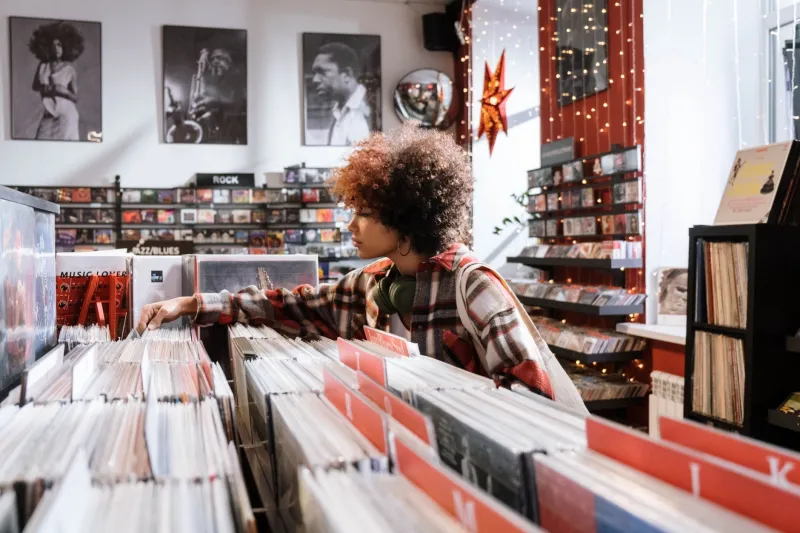
Somewhere in a suburban strip mall in 1994, a teenager is flipping through record bins at a music store. She's not looking for anything specific. She picks up a CD because the cover looks interesting. She's never heard of the band. She spends $14.99 on a gamble, drives home, and discovers her favorite album of the decade.
That story is almost impossible to replicate today. Not because good music stopped being made — but because the entire system that made that kind of accident possible has been replaced by something that is, by design, far less accidental.
The Art of the Browse
Before Spotify's Discover Weekly, before Netflix's "Because You Watched" row, before Amazon's perpetual parade of suggestions, discovery was a physical and social experience. It required showing up somewhere, talking to someone, or stumbling across something you weren't looking for.
Video rental stores were a masterclass in this. You walked in on a Friday night with a vague sense of what you wanted — something funny, maybe, or something with that actor you liked — and you left with something else entirely because the box caught your eye or a stranger in the aisle said "oh, that one's actually great." The serendipity was baked into the friction.
Record stores worked the same way. The bins were organized, but not algorithmically. You might go in for one thing and come out with three others because a handwritten staff recommendation card made a compelling case, or because the store was playing something over the speakers you'd never heard before. Tower Records, Sam Goody, and thousands of independent shops were, in a very real sense, curated discovery machines — operated by humans with taste, not behavioral data.
Libraries were perhaps the greatest accidental discovery engines ever built. The Dewey Decimal System might have been logical, but browsing a shelf meant encountering books shelved near the one you wanted — books that had nothing to do with your original search but everything to do with where your afternoon was about to go. Serendipity lived in the adjacent shelf.
The Human Algorithm
Before recommendation engines, the most powerful discovery tool most people had was other people. A friend who knew your taste. A coworker who pressed a paperback into your hands and said "trust me." A radio DJ who played a deep cut at 11 p.m. and changed someone's entire musical trajectory.
These recommendations were imperfect, biased, and sometimes completely wrong for you. But they came from somewhere real — from a person who had experienced something and wanted to share it. There was a transactional intimacy to it that no algorithm has ever quite managed to replicate.
TV Guide, the little magazine that sat next to the remote in American living rooms for decades, was another form of this. You'd flip through it on a Sunday night, circling things that looked interesting, occasionally stumbling onto a documentary or a late-night film that had no business being as good as it was. The constraint of a fixed broadcast schedule meant you watched what was on, and sometimes what was on was a revelation.
What the Algorithm Gave Us
It would be dishonest to pretend that algorithmic recommendation hasn't delivered real value. Spotify has introduced millions of people to artists they never would have found on their own. Netflix has surfaced films that might otherwise have disappeared into obscurity. The sheer volume of available content today — music, books, films, podcasts, shows — is so vast that some form of filtering is simply necessary.
The convenience is genuine. The personalization, at its best, is genuinely useful. If you loved a particular kind of thriller, there's something efficient and satisfying about a system that knows to show you more of it.
But efficiency and discovery are not the same thing. In fact, they're often in tension.
The Filter Bubble You Didn't Sign Up For
Here's the quiet cost of algorithmic discovery: it is, by definition, backward-looking. It recommends based on what you've already demonstrated you like. It is optimized for engagement, for keeping you on the platform, for giving you more of what kept you there last time. It is very good at delivering the expected and very bad at delivering the genuinely surprising.
The record store bin had no idea what you'd listened to before. The library shelf didn't know your reading history. The friend who handed you a book didn't run a regression analysis on your preferences first. These systems delivered things that were sometimes wrong, sometimes strange, sometimes confusing — and occasionally, life-changingly right in ways you never anticipated.
There's also an agency question worth sitting with. When an algorithm decides what to surface, and that algorithm is operated by a company with a financial interest in your continued engagement, the question of whose interests are being served gets complicated. You think you're discovering something. You're actually being shown something. Those aren't always the same thing.
The Effort That Made It Mean Something
There's one more dimension to this that doesn't get talked about enough: the role of effort in making discovery feel significant.
Finding something great when you had to work for it — when you spent forty minutes in a used bookstore, or drove across town to the one record shop that carried imports, or stayed up late watching a film on cable that you'd never heard of — meant something. The effort was part of the value. The story of how you found it became part of what made it yours.
Today, the story is usually "the app suggested it." Which is fine. But it's a different kind of relationship with the thing you found.
We didn't lose the ability to discover things. We outsourced it. And like most things we outsource, we got efficiency in return — and gave up a little bit of the magic.