When There Was Nothing On, Kids Got Good at Something: The Lost Education of an Empty Afternoon
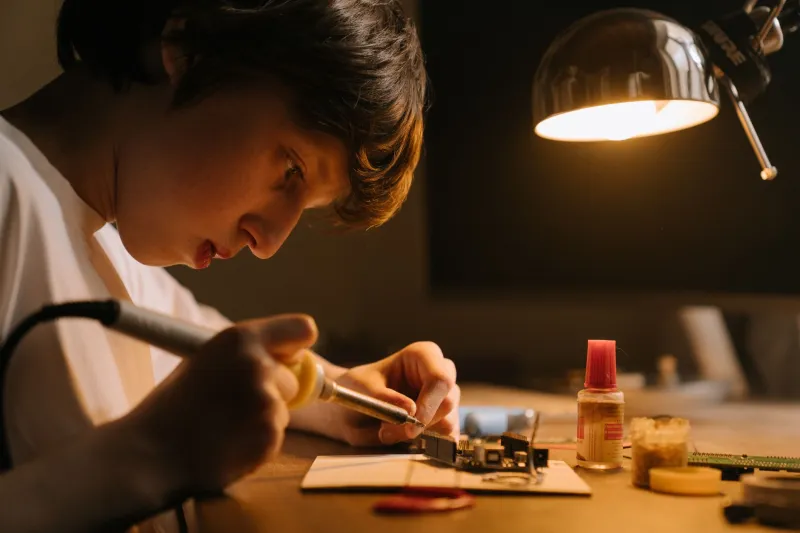
Somewhere around 1991, a fourteen-year-old in suburban Michigan sat down on a Saturday afternoon with the instruction manual for a used shortwave radio he'd bought at a garage sale for three dollars. There was nothing good on TV. His friends weren't around. The manual was sixty-two pages long and not particularly well written.
He read every page.
By Sunday evening, he understood how radio frequencies worked, what single-sideband modulation meant, and how to tune into stations broadcasting from South America. He didn't set out to become knowledgeable about radio. He just had nothing else to do.
The Curriculum Nobody Designed
Pre-internet childhood had a feature that nobody appreciated at the time because it didn't feel like a feature. It felt like a problem. That feature was boredom — real, extended, unresolved boredom that couldn't be fixed with a phone.
When the three TV channels had nothing good on, when the library was closed, when it was raining and your friends were busy, you were left alone with whatever was around you. And what was around you, if you were the kind of kid who paid attention, was often surprisingly interesting. Old electronics. Thick books with small print. Instruction manuals. Encyclopedias. How-to guides. Magazines about things you'd never thought to care about.
You read them not because someone assigned them, but because the alternative was staring at the ceiling.
This sounds like a minor thing. It wasn't. That kind of unstructured, curiosity-driven absorption is exactly how deep knowledge forms. Cognitive scientists have a term for what happens when the brain isn't being actively stimulated from the outside — the default mode network kicks in, and the mind starts making connections, consolidating information, generating ideas. Boredom, it turns out, is productive in ways that constant stimulation isn't.
What Kids Actually Did With Empty Time
Let's be specific, because nostalgia has a tendency to smooth out the details.
Kids in the 1970s, 1980s, and early 1990s did plenty of mindless things with their free time. They watched whatever was on TV even when it wasn't good. They goofed off. They got into trouble. Boredom wasn't some magical state of enlightenment.
But the absence of a device engineered to capture and hold attention meant that boredom eventually pushed people toward doing something. And "something" often turned into a skill.
The kid who took apart the broken radio and couldn't figure out how to put it back together started reading about circuits. The teenager who wanted to understand why her favorite songs sounded the way they did started reading about music theory from a library book. The boy who got a chemistry set and exhausted the included experiments started reading the explanations of why the reactions worked. Nobody told them to. The gap in their entertainment schedule just left room for it.
Computer hobbyists of the early 1980s are a famous example of this dynamic. The machines were complicated, the documentation was dense, and there was no YouTube tutorial to walk you through it. If you wanted your Commodore 64 to do something it didn't already do, you had to read, experiment, fail, and try again. That process — slow, frustrating, and completely self-directed — produced some of the most technically capable people in American history.
What Replaced the Empty Afternoon
The smartphone didn't just add entertainment options. It fundamentally changed the relationship between young people and unoccupied time.
Boredom now has a resolution time measured in seconds. The moment discomfort arrives, a device is there to eliminate it. Waiting for food at a restaurant. Sitting in a car. Waking up before the rest of the house. Every gap in stimulation gets filled immediately, automatically, and with content specifically designed by teams of engineers to be as engaging as possible.
This isn't a moral failing. It's a completely rational response to the environment. If someone offers you something interesting every time you feel bored, you take it. The problem is what gets crowded out.
Deep reading — the kind where you sit with a complicated text for an hour and work through it — requires tolerating confusion and resisting the urge to do something else. Tinkering with a broken device requires sitting with frustration long enough to figure out what's wrong. Developing genuine expertise in anything requires spending time with difficult material when easier options are available.
When the easier option is always available and always optimized for immediate satisfaction, the harder path gets harder to choose.
The Attention Economy Didn't Invent Distraction — It Just Won
Distraction has always existed. Kids in 1955 could waste an afternoon just as thoroughly as kids in 2005. The difference is scale and design.
Modern platforms aren't passively available the way a television was. They're actively competing for attention, using behavioral data and feedback loops to maximize engagement. The instruction manual for a shortwave radio never tried to keep you reading it. It just sat there, waiting to be useful if you decided to pick it up.
That distinction matters more than it sounds.
What Actually Gets Lost
The real casualty isn't knowledge about shortwave radios or chemistry sets. It's the experience of choosing to go deep on something because nothing easier was available — and discovering, partway through, that you actually wanted to know.
That experience is how a lot of people figured out what they were genuinely good at. Not through a career aptitude test or a school assignment, but through an unplanned Saturday afternoon that turned into an obsession.
The empty afternoon wasn't wasted time. For a lot of people, it was the most important time they ever had. They just didn't know it while it was happening.