One Hour of Your Life, Gone: The Gamble Every American Took Just to Get a Haircut
Think about the last time you booked a haircut. You probably opened an app, picked a time slot that fit your schedule, and showed up within a two-minute window of your appointment. The whole thing felt about as complicated as ordering a pizza.
Now think about what that same errand looked like in 1988.
The Walk-In Era Was a Commitment, Not a Convenience
For most of the 1970s, 1980s, and well into the 1990s, the overwhelming majority of barbershops and hair salons across America operated on a pure walk-in basis. There were no appointments. There were no callback systems. There was no way to check ahead of time how many people were sitting in those vinyl chairs before you.
You simply drove over, walked through the door, and found out.
Sometimes you got lucky. You'd arrive on a Tuesday morning to find two empty chairs and a barber who waved you straight over. You'd be back in your car before the engine had fully cooled. Those were good days. You felt like you'd beaten the system.
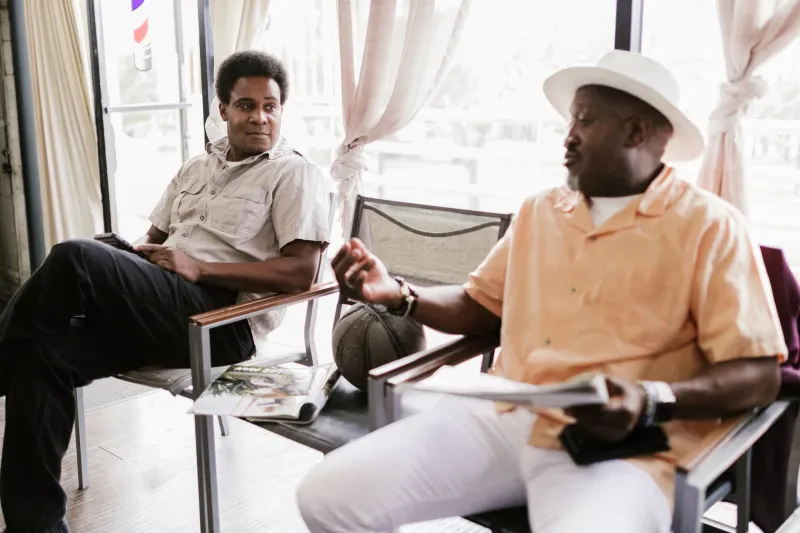
But plenty of other times — most times, if you were unlucky enough to show up on a Saturday or right after work on a Friday — you'd walk in to find six people ahead of you, a stack of Sports Illustrated magazines from three months ago, and absolutely no way to know how long the wait would be. So you sat down. And you waited.
The Math Nobody Could Do
Here's what made the experience genuinely maddening: there was no reliable way to estimate your wait. A haircut might take fifteen minutes for a simple trim on a no-nonsense regular, or forty minutes for someone who wanted a consultation, a style change, and a long conversation about the local football team. You couldn't tell from looking. The barber couldn't tell you with any confidence either.
Some shops kept a paper sign-in sheet by the door. You'd write your name on a list, which at least gave you the illusion of order. But the list didn't tell you anything useful — not how many cuts were ahead of yours, not how long each one might take, not whether someone three spots up was getting a buzz cut or a full reshape.
You were essentially making a bet with your afternoon. And the house had all the information.
The Invisible Cost Nobody Counted
What's striking, looking back, is how completely ordinary all of this felt at the time. Americans weren't outraged by the walk-in barbershop system. They weren't writing letters to the editor about it. It was just the way things were, the same way traffic jams and busy signals were just the way things were.
But the hidden cost was real. If you needed a haircut before a job interview on Thursday, you couldn't just slot it in during your lunch break with any confidence. You had to plan for the possibility that it might eat your entire lunch hour and bleed into the afternoon. People with demanding jobs or young kids at home had to treat a simple trim as a logistical challenge — something to plan around, not something to fit in.
Saturday mornings at the barbershop were practically a cultural institution in American towns, partly because that was the only time many people could afford to lose to the wait. You'd bring your kid, grab a magazine, and mentally write off the next ninety minutes.
What Changed Everything
The shift happened gradually, then all at once. Online booking tools began appearing in the early 2000s, first for higher-end salons and then slowly spreading to neighborhood barbershops. But the real transformation came with smartphones and purpose-built apps like StyleSeat, Booksy, and the booking systems built directly into Google and Yelp.
Suddenly, a shop that had operated on walk-ins for thirty years could offer real-time appointment slots, automated reminders, and digital waitlists that sent you a text when your chair was ready. Customers could look at a live calendar and see that the 11:15 slot was open on Wednesday. They could book it from their couch at midnight. They could cancel with 24 hours' notice without making an awkward phone call.
For the customer, the uncertainty simply evaporated. For shop owners, no-shows became a manageable problem rather than a daily crisis.
Something Small, Something Significant
A haircut is a minor thing in the grand scheme of a life. But the story of how we used to get one captures something important about how dramatically the texture of everyday American life has changed.
We used to absorb enormous amounts of low-grade friction as a matter of course — wasted time, unresolved uncertainty, small indignities that added up across a week or a month or a year. We didn't think of it as a problem because we had no frame of reference for anything better.
Now we do. And once you've booked a haircut from your phone at 10pm and walked in to an empty chair at exactly your appointed time, the idea of showing up and just hoping for the best feels almost unimaginable.
The barbershop is still there. The small talk is still the same. But the gamble is gone — and most of us have already forgotten we were ever making it.