Twenty-Four Volumes of Almost-Right: What American Families Sacrificed to Own the Encyclopedia — and Why It Was Never Quite Enough
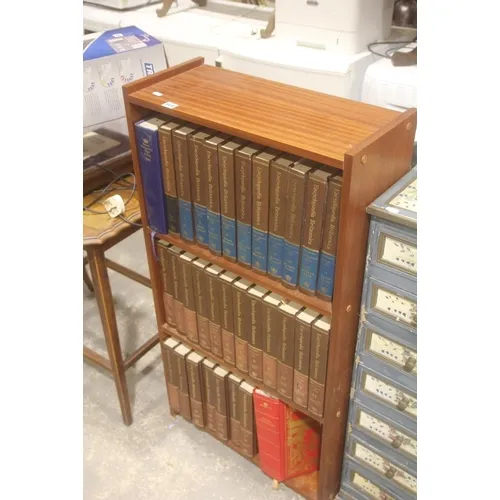
Photo: encyclopedia britannica set bookshelf 1970s family living room, via content.easyliveauction.com
The salesman usually came in the evening, when both parents were home. He wore a good suit and carried a briefcase, and he knew better than to open with the price. He opened with the children.
How old are they? What grade? Do they struggle with homework? Do you want them to have every advantage? He'd pull out a single gleaming volume — maybe the letter M, because M had mountains and medicine and Mozart — and let the parents feel the weight of it. Quality binding. Thick pages. Color photographs. Then, almost as an afterthought, he'd mention that the full set was available for a very reasonable monthly payment.
For decades, this scene played out in living rooms across America, and it worked. Millions of families bought encyclopedias they couldn't quite afford, because the alternative felt like telling your kids that their education wasn't worth the investment.
The Weight of Knowledge on a Payment Plan
A full set of Encyclopedia Britannica in the 1970s cost somewhere between $400 and $1,400 depending on the edition and binding — roughly equivalent to $2,000 to $7,000 in today's money. World Book ran somewhat cheaper but still represented a significant household expense. Most families didn't pay upfront. They signed installment agreements: so much per month for two or three years, with interest, for books that would sit on a dedicated shelf in the living room like a piece of furniture with ambitions.
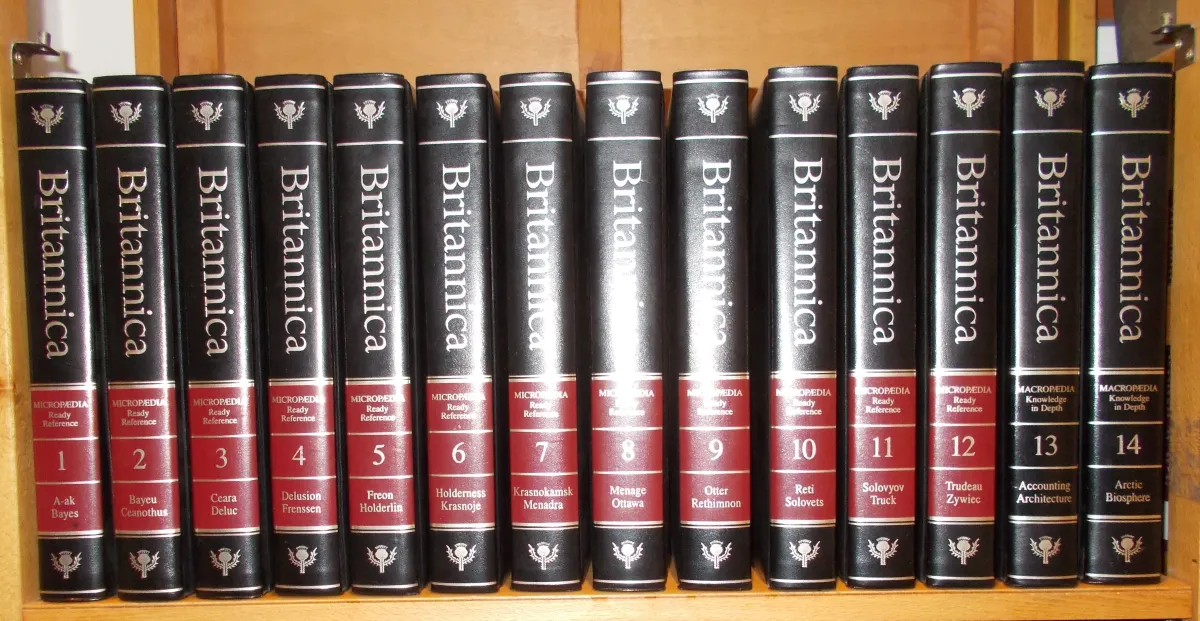 Photo: Encyclopedia Britannica, via pictures.abebooks.com
The shelf mattered. Families didn't hide their encyclopedias in a closet. They displayed them — in the den, in the living room, sometimes in a purpose-built bookcase that came as part of the package. Twenty-four matching volumes with gold lettering on the spines communicated something to visitors. It said: this family takes education seriously. This family invested in its children's future in a tangible, physical way.
And for a while, the encyclopedias delivered. For a child doing a report on the American Revolution or the solar system or the history of ancient Rome, cracking open the appropriate volume and finding dense, authoritative text and detailed illustrations was genuinely useful. The information was curated by experts. It was organized. It was reliable — or at least, it had been reliable at some point.
 Photo: American Revolution, via i.poweredtemplates.com
The Problem That Was Baked In From the Start
Here's the fundamental design flaw that nobody in the industry liked to discuss: encyclopedias were printed once and then frozen in time.
The research, writing, and editing process for a major encyclopedia revision took years. By the time a new edition reached the printing press, some of the information was already out of date. By the time it was sold, shipped, and installed on your living room shelf, it might be describing the population of a city that had grown by half a million people, or listing a country's leader who'd been replaced in a coup, or explaining a scientific consensus that had already shifted.
Publishers addressed this with yearbooks — annual supplements sold separately, of course — that attempted to update the main volumes. But the yearbooks created their own problem: now your authoritative reference system required cross-referencing between the main volumes and a growing stack of supplementary booklets, and even then you were working with information that was months old by the time it reached you.
Children doing homework in 1985 using a 1978 encyclopedia were working with seven-year-old data. In stable subjects like ancient history or basic mathematics, that was fine. In anything touching current events, technology, or science, it was a genuine limitation that everyone just quietly accepted.
The Salesman's Last Years
The door-to-door encyclopedia salesman was already a fading figure by the early 1990s. Encarta, Microsoft's CD-ROM encyclopedia, arrived in 1993 and offered something the physical volumes couldn't match: the ability to update and the ability to search. You didn't have to know which volume to pull. You typed a word and the information appeared.
Britannica's response was slow and somewhat panicked. The company had been selling essentially the same product — a physical, multi-volume reference set — for over two centuries. The idea that a CD-ROM costing $99 could compete with a $1,200 book set seemed almost offensive. But it was true, and the sales numbers proved it quickly.
Then came the internet, and the conversation was over.
By the late 1990s, anyone with a dial-up connection could access more information than twenty-four volumes could hold, and it was being updated continuously. By 2001, Wikipedia had launched, offering something encyclopedias had never attempted: an open, collaborative, constantly revised reference that treated knowledge as a living thing rather than a fixed product. Encyclopedia Britannica stopped publishing its print edition in 2012, after 244 years. The announcement was treated, accurately, as the end of an era.
What Those Bookshelves Actually Meant
It would be easy to look back at the encyclopedia era with condescension — all that money, all those payment plans, for books that were wrong about current events before they even arrived. But that reading misses something important.
The families who bought encyclopedias weren't being naive. They were making the best investment available to them with the tools that existed. A home library of curated, expert-reviewed knowledge was genuinely valuable in a world where the alternative was driving to the public library and hoping the reference section had what you needed.
More than that, the encyclopedia represented a specific kind of parental aspiration — the belief that knowledge was worth sacrifice, that a child's curiosity deserved a serious answer, that education was something you invested in physically and kept in the home. The shelf full of matching volumes was a promise: whatever you want to learn, we'll try to have it here for you.
The internet fulfilled that promise in ways the encyclopedia industry could never have imagined. Information is now free, instant, and continuously updated. A ten-year-old with a phone can access more knowledge in thirty seconds than those twenty-four volumes contained.
But nobody's parents made payments for three years to own it. And somehow, that changes what it feels like.