Waiting for Words That Might Never Come: What It Actually Meant to Love Someone Across a Distance
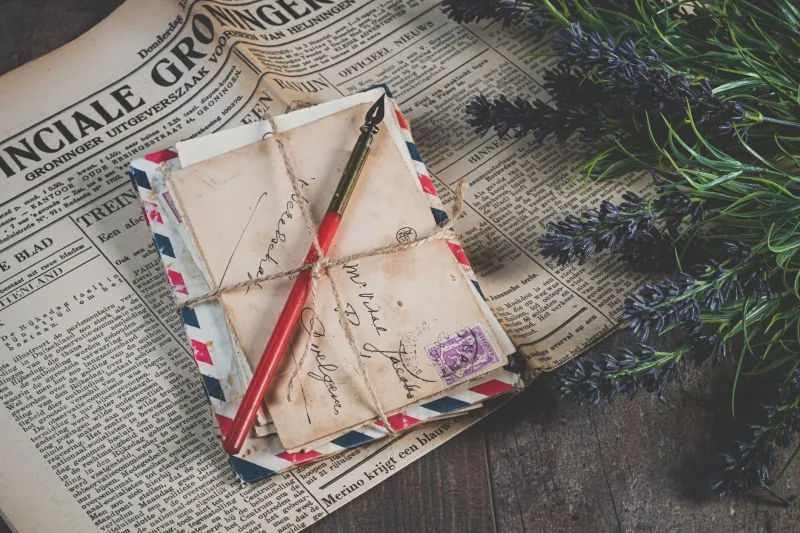
Imagine writing a letter to someone you love. You pour everything into it — the small details of your week, a joke you thought they'd find funny, the honest admission that you miss them more than you expected. You seal it, stamp it, walk it to the mailbox. And then you wait. Not hours. Not a day. You wait a week, maybe more, for the possibility of a reply.
That was long-distance love before the digital age. Not a romantic inconvenience. An actual test of faith in another person and in the relationship itself.
The Letter Was Everything
For much of the twentieth century, written correspondence was the primary way separated couples stayed connected. This wasn't just a pre-smartphone phenomenon — it was true well into the 1980s for anyone who couldn't afford regular long-distance calls. The letter was the relationship, in a very real sense. You learned to write honestly and specifically, because you knew your words had to carry the full weight of your presence.
People kept those letters. Bundled with rubber bands, stored in shoeboxes, hidden under beds. They were reread. Sometimes obsessively. A single letter from someone you loved could be read ten times in a week because it was the only version of them you had access to.
The writing itself changed how people communicated. You couldn't fire off a quick complaint and expect an immediate apology. By the time your frustration arrived in someone's mailbox, you'd already had a week to reconsider whether it was worth sending. Misunderstandings had a long lag time. Arguments were slow-motion. Some couples resolved problems before the other person even knew there was one.
The Phone Call Was a Special Occasion
Long-distance phone calls in the 1970s and 1980s were genuinely expensive. AT&T's long-distance rates before deregulation could run over a dollar per minute — and that's in the dollar values of the time. A twenty-minute call between, say, Chicago and San Francisco could cost more than a family's grocery budget for a day. People planned those calls. They made lists of things to say beforehand so they wouldn't waste a single minute.
There was a ritual to it. You agreed in advance on a time, because there was no voicemail for most households until the late 1980s, and missing the call meant starting the whole coordination process over again by letter. When the phone rang at the appointed hour, the whole household knew what it meant. Siblings were shooed out of the room. Parents gave privacy. The call was an event.
Even into the 1990s, before cell phones became common, calling someone long-distance still carried a cost that made every conversation feel deliberate. You didn't call to chat idly. You called because you had something to say.
What Separation Actually Felt Like
The emotional texture of long-distance relationships before modern communication technology was qualitatively different from anything couples experience today. The gaps were real. A week with no word from someone you loved wasn't unusual — it was the norm. You learned to hold uncertainty without being consumed by it.
There was no way to send a quick "thinking of you" message when a song came on the radio that reminded you of them. No way to share a funny moment from your afternoon in real time. No way to see their face when you needed reassurance. The distance was actual distance, felt in the body, not just the inconvenience of different time zones on a video call.
Relationships that survived long separations in that era had to be built on something durable — shared history, clear commitment, a mutual willingness to tolerate a kind of loneliness that modern couples rarely have to sit with. The divorce and breakup rates among couples separated by military deployment, college, or career moves were significant partly for this reason. The tools to sustain intimacy across distance simply didn't exist in the way they do now.
The Photograph You Carried
One detail that captures the era perfectly: the photograph. Before digital cameras and phone galleries containing thousands of images, couples who were separated often had a single photograph of each other. One. Carried in a wallet, taped to a dorm room wall, kept on a nightstand.
That photograph had to do enormous emotional work. It was the only visual access you had to someone's face between visits. People describe staring at those photographs in ways that sound almost startling now — trying to remember details that were already beginning to fade, studying expressions for clues about how the person was feeling when the picture was taken.
Today, a couple separated by a cross-country move can video call every night, send dozens of photos throughout the day, share playlists, watch the same show simultaneously from different cities, and send voice messages that capture tone and laughter in a way text never could. The distance is still real. The emotional difficulty of separation hasn't disappeared. But the tools available to bridge that gap have transformed completely.
Something Lost, Something Found
It would be easy to romanticize the old way — the handwritten letters, the intentional phone calls, the slow burn of waiting. And there was something genuinely meaningful about communication that cost time and effort. Those letters were artifacts. They said: I sat down and thought about you for an hour. That kind of deliberateness is harder to replicate in an era of instant messaging.
But the suggestion that something was lost when communication became easy misses the other side of the ledger. Relationships that might have survived, that might have grown into something lasting, were ended simply by the weight of the silence. The cost wasn't romantic — it was real. People lost each other not because their feelings faded, but because the infrastructure to sustain those feelings across distance didn't exist.
What we have now isn't a lesser version of connection. It's a fundamentally different one. And for anyone who ever watched a relationship dissolve into the gap between two mailboxes, the difference matters enormously.