The Man Who Fixed Your Television: Inside the House Call That Vanished
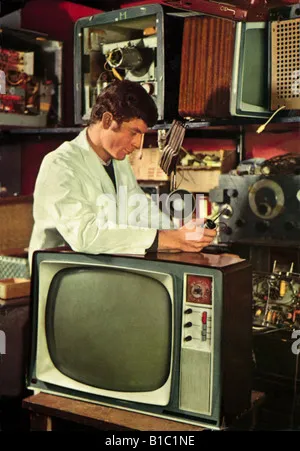
Photo: vintage TV repairman fixing console television vacuum tubes 1960s, via l450v.alamy.com
If you grew up in America before roughly 1985, you probably remember him: a man in work clothes, carrying a leather satchel, kneeling behind the family television with the back panel off, the set's glowing insides spilling blue light onto the living room wall.
The TV repairman wasn't a specialist you called in a crisis. He was a recurring character — like the mailman or the milkman. Some families saw him a few times a year. And his disappearance tells you almost everything you need to know about how our relationship with technology transformed in a single generation.
A Television Was Furniture, Not a Device
The first thing to understand is scale. A 1960s console television wasn't something you picked up. It was a piece of furniture — often literally built into a wooden cabinet that matched the living room set, weighing anywhere from 100 to 300 pounds. Families arranged their living rooms around it the way earlier generations arranged rooms around the fireplace.
Inside that cabinet was technology that failed constantly. The picture was produced by a cathode ray tube, and the rest of the circuitry ran on vacuum tubes — glass components that glowed, ran hot, and burned out the way light bulbs do. A set might contain two dozen of them.
When the picture collapsed into a horizontal line or the sound died, the odds were good that a single tube had failed. And here's the part that sounds like science fiction today: many Americans diagnosed the problem themselves. Drugstores and hardware stores kept tube-testing machines by the door. You'd pull the tubes out of your set, carry them down in a paper bag, plug each one into the tester, and buy a replacement for the dud. It was DIY electronics for the masses.
The Repairman's Economics Made Sense — Then Didn't
For the failures a tube-pull couldn't fix, the repairman came to you. House calls typically ran $10 to $25 in the 1960s — real money, but justifiable when a new set cost $300 to $500, the equivalent of several thousand dollars today.
Repair made economic sense because televisions were expensive, heavy, and built to be serviced. Manufacturers designed sets with accessible chassis and standardized parts. Schematics were available. The whole industry assumed your television would live in your family for fifteen or twenty years, and would be opened up and fixed multiple times along the way.
The Three Deaths of the Repairman
The profession didn't fade gradually. It was killed by three distinct technological shifts, each arriving within about twenty years.
First came the transistor in the 1960s and '70s, which replaced hot, fragile vacuum tubes with solid-state circuits that essentially never wore out. The most common failure — the burned-out tube — simply ceased to exist.
Second came manufacturing economics. As mass production drove the price of a new set down and down, the equation flipped. By the 1980s, a repair quote of $75 against a new set at $200 wasn't a hard call. People stopped repairing because replacement became the rational choice.
Third came the flat screen. When CRTs gave way to LCD and plasma panels in the 2000s, the television lost its weight, its cabinet, and its serviceability all at once. Modern panels are glued and ribbon-cabled assemblies that even professional technicians often declare unrepairable. The thing you can now mount on a wall is, functionally, a sealed disposable object.
We Used to Know What Was Inside
There's a subtler loss here than the repair bills. When televisions failed visibly — tubes glowing, fuses blowing, static patterns that meant something — ordinary people had a fighting chance of understanding the machine. There was a folk literacy around electronics. Dads knew which tube was which. Kids learned circuit logic from heath kits.
Today's devices fail invisibly. A black screen could mean a dead backlight, a failed board, or a software crash, and no amount of intuition will tell you which. We've traded understandable fragility for opaque reliability — and honestly, most of us would take that trade again. The modern TV almost never breaks.
But when it does, the satchel-carrying man who could open it up and bring the picture back to life is gone. The television went from being the most repaired object in the American home to one of the least repairable, and the entire profession that supported it dissolved so quietly that most of us never noticed the house calls had stopped.