Nothing to Do and Nowhere to Be: The Vanishing Art of an Unscheduled Afternoon
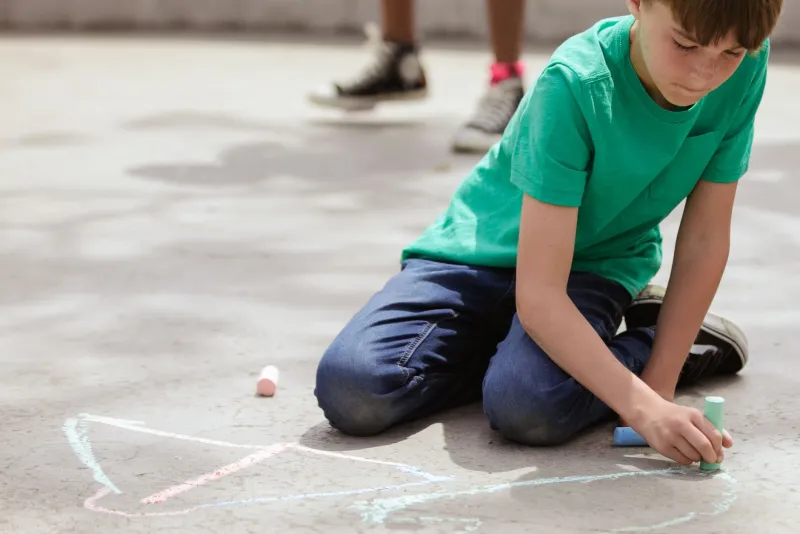
It's a Saturday afternoon in the summer of 1988. You're twelve years old. You've already eaten lunch, your friends are either at family stuff or just not around, there's nothing on TV except a baseball game you don't care about, and your mom has made it clear that sitting inside complaining is not an option. So you go outside. You wander. Maybe you end up at the creek a few blocks away, turning over rocks for no real reason. Maybe you build something weird out of scrap wood in the garage. Maybe you just lie in the backyard staring at clouds until your brain starts doing something unexpected.
That experience — that particular texture of having nothing to do and no device to fill the silence — is something an entire generation of American kids has now grown up without. And the implications are bigger than most people realize.
The Saturday That Belonged to Nobody
For most of the twentieth century, unstructured time was simply a fact of childhood. After school, on weekends, during those long shapeless summer days, kids were largely left to their own devices — which is to say, their own imagination, their own neighborhood, and their own tolerance for restlessness. Parents weren't hovering with activity schedules. There was no algorithm waiting to serve up the next video the moment attention started to drift.
Boredom, in that environment, wasn't a problem to be solved. It was a threshold you passed through. Psychologists who study childhood development have long noted that the discomfort of having nothing to do is actually the starting point for creative thought. When your brain isn't being fed external stimulation, it starts generating its own. You make up games. You build things. You get into mild trouble that teaches you something about consequences. You daydream in ways that, it turns out, are neurologically productive.
The research backs this up in ways that might surprise you. A study from the University of Central Lancashire found that participants who were given a boring task first performed better on subsequent creative challenges than those who jumped straight to the creative work. Boredom, the researchers concluded, encourages the kind of mind-wandering that leads to original thinking. It's not a bug in the system. It's a feature.
What Happened When the Feed Arrived
Smartphones became genuinely ubiquitous among American teenagers around 2012 and 2013. Social media, streaming video, mobile gaming, group chats — all of it arrived more or less simultaneously in the pockets of an entire generation, and the effect on unstructured time was immediate and total. The average American teenager now spends somewhere between seven and nine hours per day consuming digital media outside of school. That leaves very little room for the kind of purposeless, undirected time that used to be standard.
The shift wasn't just about entertainment. It changed the fundamental experience of being alone with your own thoughts. For previous generations, solitude was a regular part of daily life — walking to school without headphones, sitting in a waiting room without a phone, lying in bed at night with nothing but your own mental chatter for company. Those moments, accumulated over years, built something: a tolerance for internal silence, a capacity for self-reflection, a comfort with your own company that doesn't depend on external validation.
For a generation that has grown up with constant connectivity, those moments are vanishingly rare. And researchers are increasingly concerned about what that means. Jean Twenge, a psychologist at San Diego State University who has studied generational trends extensively, has documented a significant rise in anxiety, loneliness, and depression among American teenagers that correlates closely with smartphone adoption — not because phones are inherently harmful, but because they've displaced the unstructured time and face-to-face interaction that adolescent development actually requires.
The Lost Curriculum of Boredom
Here's what a boring Saturday afternoon used to teach you, without anyone intending to teach you anything.
It taught you that discomfort passes. The restless, itchy feeling of having nothing to do would eventually resolve — not because someone handed you a solution, but because your own brain found a way through it. That's a skill. Learning to sit with discomfort without immediately escaping it is foundational to emotional regulation, and it's a skill that requires practice.
It taught you to initiate. When nobody was organizing your time, you had to decide what to do. That meant making choices, tolerating the uncertainty of not knowing if they'd work out, and sometimes failing in small, instructive ways. You knocked on a friend's door and they weren't home. You started a project and abandoned it. You figured out what you actually liked, separate from what was being served to you.
It taught you to be present in physical space. You noticed things — the way afternoon light hit the sidewalk, the sound the screen door made, the particular smell of a summer rainstorm coming in. None of that is romantic exaggeration. It's just what happens when your attention isn't pre-occupied.
Making Space for Emptiness
None of this means smartphones are purely destructive or that every moment of digital entertainment is a developmental failure. The tools available to young people today are genuinely remarkable, and plenty of teenagers use them creatively and thoughtfully. The concern isn't the technology itself — it's the completeness of the displacement.
What's been lost isn't just leisure time. It's a specific kind of mental experience that previous generations stumbled into by default, one that turned out to be quietly essential. The good news is that it doesn't require a radical intervention to partially restore it. An hour without a phone. A Saturday morning with no plans and no screens. A car ride without headphones.
Boredom is not the enemy of a good childhood. It might be one of its most underrated ingredients.
We just didn't know that until it was mostly gone.