The Debate That Died at Dinner: When Nobody Could Prove Anything and Everyone Went Home Unsure
Somewhere in the mid-2000s, a specific kind of conversation quietly went extinct. You might not have noticed it leaving. But if you grew up before smartphones were in every pocket, you remember it well: the argument that simply ended without a resolution, because nobody could look anything up.
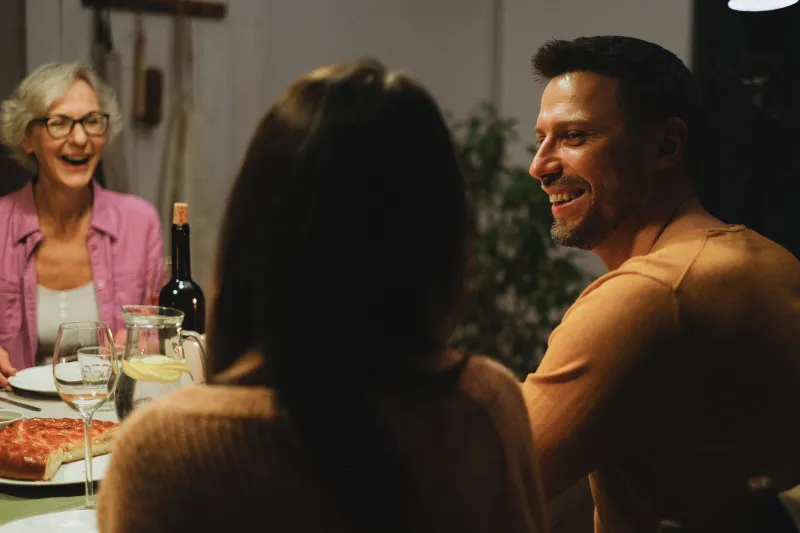
You'd be at Thanksgiving dinner, or a backyard barbecue, or a long drive with your dad, and someone would make a claim. Someone else would push back. Voices would rise slightly. Someone would invoke a half-remembered statistic, someone else would dispute it, and then — after a few rounds of "I'm pretty sure" and "No, I think you're thinking of something else" — the whole thing would just dissolve. You'd move on to something else. The question would drift unanswered into the evening air.
That experience is almost impossible to replicate today.
The Phone on the Table Has Changed the Rules
Now, the moment a factual dispute emerges at any social gathering, someone reaches for their phone. Usually within thirty seconds. The answer arrives, the debate collapses, and whoever was right gets a brief moment of vindication before the conversation moves on.
It's efficient. It's accurate. It eliminates the particular frustration of knowing you're right but being unable to prove it.
But it has also quietly altered the texture of human disagreement in ways that are worth thinking about. When every factual question has an immediate answer, arguments become less about reasoning through uncertainty together and more about racing to be the person who pulls out their phone first. The goal shifts from working it out to winning it.
And winning, it turns out, is a very different thing.
What Uncertainty Used to Do for a Conversation
When nobody could look anything up, disagreements had a different shape. They required people to actually engage with each other's reasoning rather than outsourcing the verdict to a search engine.
If your uncle claimed that a particular baseball player held a certain record, and you weren't sure he was right, you had to decide: is this worth pushing? How confident am I? What do I actually remember? You'd weigh your certainty against his. You'd think about where you might have learned what you thought you knew. The conversation stayed in the room, inside the people having it.
Sometimes you'd realize mid-argument that you were less sure than you'd initially felt. That recalibration — that quiet moment of intellectual humility — happened naturally, because you had nothing to lean on except your own memory and reasoning.
Today, that moment rarely comes. You don't need to recalibrate if you can just verify.
The Social Cost of Always Being Able to Prove It
There's something that gets lost when every argument has a referee available on demand: the willingness to let other people be wrong in peace.
In the pre-smartphone era, if someone said something factually questionable at a dinner party, the social calculus was different. You might let it go. Not because you were a pushover, but because challenging it would require an extended back-and-forth with no clean resolution, and sometimes that just wasn't worth the energy. You'd file it away mentally, move on, and maybe bring it up later if you happened to find a reference.
Now, the cost of challenging someone is extremely low. The phone is right there. The answer takes ten seconds. And so people challenge more, correct more, and — perhaps not coincidentally — find themselves in more petty conflicts over things that ultimately don't matter much.
There's research suggesting that the availability of instant information has made people more confident in their own views, not less — because they've learned they can quickly find sources that support whatever they already believe. The internet didn't just give us facts. It gave us the ability to weaponize facts selectively, and we've been doing it ever since.
The Shared Uncertainty Was Its Own Kind of Bond
Here's something that sounds strange until you really sit with it: not knowing the answer together was a form of intimacy.
When two people were equally in the dark about something — both half-remembering, both piecing together fragments, both genuinely uncertain — they were in a collaborative state. They were thinking alongside each other rather than against each other. The conversation had a different energy. It was exploratory rather than adversarial.
That kind of shared uncertainty created space for stories. "I think I read somewhere that..." would lead to a tangent. The tangent would lead to a memory. The memory would lead somewhere else entirely. The original question would get forgotten, and you'd end up somewhere more interesting than an answer.
Search engines don't do tangents. They do answers. And answers, for all their utility, have a way of closing conversations rather than opening them.
We Know More. We're Not Sure It's Better.
The before-and-after here isn't a clean moral story. Misinformation flourished in an era when nobody could fact-check anything. Urban legends spread for decades because there was no easy way to debunk them. False beliefs took root and stayed rooted because the correction was too hard to find.
Instant access to accurate information is a genuine good. It would be absurd to pretend otherwise.
But something specific about human connection — something related to sitting with not-knowing, to reasoning together in the dark, to letting a question live unresolved for a while — has been quietly retired. We traded it for the comfort of certainty, and most of the time we don't miss it.
Until someone pulls out their phone at dinner to prove a point that didn't need proving, and the conversation stops, and you realize the argument was never really about the answer — it was about the talking.