Printed, Framed, Forgotten: How the Camera Roll Replaced the Memory
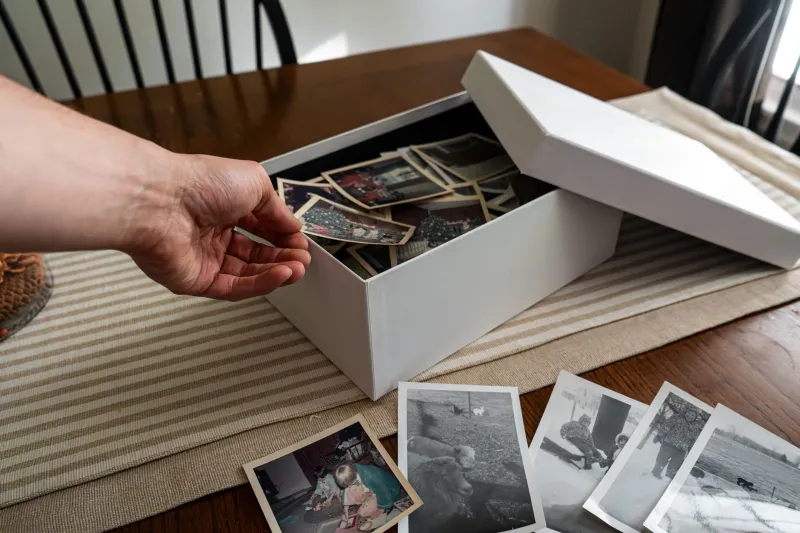
Somewhere in your parents' house — or maybe your grandparents' — there's a shoebox. Maybe it's under a bed, maybe it's on the top shelf of a closet behind a stack of board games nobody plays anymore. Inside that box are photographs. Not many, really. A few hundred at most, covering decades of birthdays, vacations, graduations, and ordinary Sundays that somehow seemed worth recording. You can hold each one. You remember most of them. Some of them still make you stop.
Now open your phone. How many photos do you have?
For most Americans, the answer is somewhere between unsettling and absurd. Thousands. Tens of thousands. Blurry shots of meals, seventeen nearly-identical selfies taken in the same minute, screenshots of memes, accidental photos of the inside of your pocket. The contrast between that shoebox and your camera roll might be the quietest way to describe how dramatically our relationship with memory — and meaning — has shifted.
When a Photo Cost You Something
Before digital cameras became standard household items in the early 2000s, taking a photograph involved real stakes. A roll of 35mm film gave you 24 or 36 exposures. That was it. You couldn't see what you'd captured until the roll was finished and sent to a drugstore for processing, which typically took anywhere from a few days to a couple of weeks. The cost of developing that roll — printing fees, sometimes the film itself — wasn't trivial for most families.
So people thought before they shot. Is this moment worth one of my 24 frames? Is the lighting okay? Is everyone looking? The scarcity of the medium created a kind of natural editing process that happened before the shutter clicked, not after. You weren't just documenting life — you were making a small editorial decision about what deserved to be remembered.
When the prints finally came back from the developer, the ritual continued. You'd flip through them at the kitchen counter, laughing at the bad ones, setting aside the keepers. Some got tucked into albums with little sticky corners. Others went into frames. The rest — yes, even then — went into the shoebox. But the total number of photographs a typical American family accumulated over a decade was manageable enough to actually look at.
The Abundance Paradox
Here's the strange thing that happened when photography became free and instant: it became less meaningful, not more.
When iPhone cameras crossed into genuinely high quality around 2012 and 2013, and when unlimited cloud storage became a realistic option, the last remaining friction in photography essentially disappeared. You could take a thousand photos on a single vacation and it cost you nothing — no film, no development fees, no waiting. The logical expectation was that this would make our visual record of life richer and more complete. And in a technical sense, it did.
But something else happened too. When every moment is potentially photographable, the act of photographing stops feeling like a choice. You shoot everything because why not? And when you shoot everything, you end up genuinely experiencing less of it. Researchers studying what's sometimes called the "photo-taking impairment effect" have found that people who photograph objects or experiences tend to remember them less clearly than those who simply observe. The camera, it turns out, can become a substitute for attention rather than a record of it.
The other side of the paradox: when storage is infinite, curation becomes optional. Most of us never delete anything. We never sit down with our digital libraries the way our parents sat with their shoeboxes. The photos exist in the cloud, technically accessible forever, but practically invisible. They pile up like unread emails, present but unexamined.
What the Shoebox Actually Preserved
There's a reason those old printed photos carry so much emotional weight when you find them. Part of it is nostalgia, sure. But part of it is the simple fact that they survived a selection process. Someone decided that moment was worth the cost of film. Someone decided the print was worth keeping. By the time a photo made it into that shoebox, it had already passed through several filters of human judgment about its value.
The physicality matters too. A printed photograph is a thing. It has texture. It can yellow at the edges. It can be written on the back — Thanksgiving 1987, Grandma's house — in handwriting you'd recognize anywhere. It exists in the world independently of any device, any platform, any company's continued operation. Digital photos, by contrast, are fundamentally dependent on infrastructure. If the cloud service shuts down, if the hard drive fails, if the file format becomes obsolete, the image is gone. The shoebox, for all its humble cardboard reality, is more archivally stable than most people's Google Photos accounts.
Taking Less, Keeping More
None of this is an argument for going back to film — the accessibility of modern photography has genuinely democratized visual storytelling in remarkable ways. Families who couldn't afford frequent film development now have rich records of their lives. Moments that once would have passed unrecorded are now preserved. That's real, and it matters.
But there's something worth sitting with in the contrast. The scarcity of the old model forced a kind of intentionality that the abundance of the new model has quietly erased. When every moment can be photographed, fewer moments feel worth truly seeing.
Maybe the lesson isn't to shoot less. Maybe it's to look more — at what you've already taken, at what's actually worth keeping, at the moments happening right in front of you before you reach for your phone. The shoebox didn't contain everything. But everything in it meant something.
That's a trade-off worth thinking about.