Five Shirts, Two Pairs of Pants, and a Sunday Best: The Wardrobe That Was Actually Enough
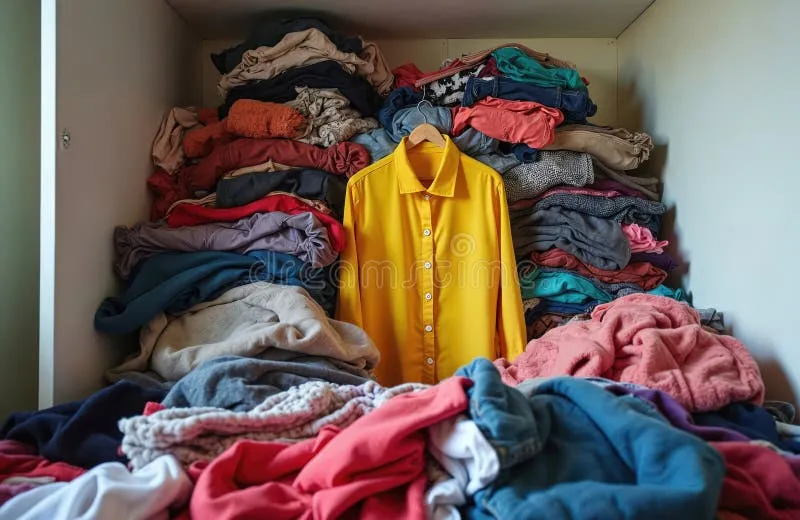
Photo: overflowing closet full of clothes fast fashion excess wardrobe, via thumbs.dreamstime.com
Open a closet in a typical American home today and you're looking at a minor archaeological dig. Clothes from three years ago still tagged. Impulse purchases from a sale that seemed too good to pass up. Items bought for a specific occasion and worn exactly once. A general mass of fabric that, if you're honest, you haven't fully inventoried since you moved in.
Now try to imagine the closet your grandmother kept. Or her mother's. A few dresses, carefully chosen. Work clothes, weekend clothes, and one outfit that got reserved for church, funerals, and anything that required a good impression. Everything worn regularly. Everything maintained. Nothing wasted.
The distance between those two closets is one of the stranger journeys in modern American consumer life.
The Wardrobe as a Considered Investment
Through most of the 20th century, clothing was expensive relative to income. In the 1950s and 1960s, a working-class American family might spend 10 to 14 percent of household income on clothes. That financial reality shaped everything about how people related to what they wore.
You bought less. You chose more carefully. You maintained what you had. Shoes got resoled. Shirts got mended. A good wool coat was an investment that lasted a decade, not a seasonal purchase. Department store shopping was a deliberate event, not a casual scroll through an app at midnight.
Kids grew up understanding that clothes were finite and valuable. Hand-me-downs weren't a sign of poverty — they were the default system. Older siblings wore things until they became younger siblings' things. The concept of a garment being disposable would have struck most mid-century Americans as genuinely strange.
And yet people dressed well. Look at photographs from the 1950s and 1960s and you'll notice something: ordinary Americans going about ordinary days look remarkably put-together. Not because they had more options, but because they had fewer — and made the most of them.
The Supply Chain That Changed Everything
The transformation began in the 1970s and accelerated sharply through the 1990s and 2000s as American clothing manufacturers moved production offshore, first to Asia and then to wherever labor costs were lowest. The price of garments, adjusted for inflation, dropped dramatically. Clothing became cheap in a way it had never been before.
When something becomes cheap enough, your relationship to it changes. A $7 t-shirt doesn't demand the same respect as one that cost the equivalent of two hours of work. The psychology of value shifts. Disposal becomes easier. Replacement becomes the default response to wear, stain, or simple boredom.
Retailers understood this and built business models around it. Zara pioneered the fast fashion model in the 1980s, turning the traditional two-season fashion cycle into something closer to 52 micro-seasons. H&M, Forever 21, and dozens of others followed. By the 2000s, the American retail landscape had been fundamentally reorganized around the idea of constant newness at minimal cost.
Today, the ultra-fast fashion brands — Shein being the most prominent — release thousands of new styles per week. The concept of a wardrobe — a considered, relatively stable collection of clothing — has been replaced by something closer to a feed: a constantly refreshing stream of options that's never complete and never quite satisfying.
The Social Media Acceleration
If cheap production was the fuel, social media was the spark. Instagram, launched in 2010, created a new social pressure around clothing that previous generations simply didn't face: the documented outfit. When photographs of your daily life are public and permanent, the idea of wearing the same thing twice in a visible context carries a social cost it never used to.
Influencer culture intensified this. Watching someone post a new outfit every day — and getting paid to do so — normalized a rate of consumption that would have seemed extraordinary even 20 years ago. Haul culture, in which people film themselves unboxing massive quantities of newly purchased clothing, became a legitimate content genre with hundreds of millions of views.
The numbers tell the story plainly. Americans now buy roughly 68 garments per year on average — nearly three times the rate of 1980. The average garment is worn seven to ten times before disposal. The United States generates about 11.3 million tons of textile waste annually, most of it ending up in landfills. About 20 percent of new clothing purchased is never worn at all.
The Cost Beyond the Price Tag
The environmental reckoning is significant. The fashion industry is responsible for roughly 10 percent of global carbon emissions — more than aviation and shipping combined. The dyeing and treatment of textiles is one of the world's largest sources of water pollution. Synthetic fabrics, which dominate fast fashion production, shed microplastics with every wash, entering water systems in quantities that researchers are still struggling to fully measure.
But there's a psychological dimension worth considering too. Studies on consumer behavior suggest that the dopamine hit of purchasing new clothing is real but short-lived. The satisfaction of owning a well-made garment that you've chosen deliberately and worn for years is a different kind of satisfaction — deeper, quieter, and more durable. Many people who've deliberately reduced their wardrobes report something unexpected: relief. The decision fatigue of a packed closet, it turns out, is genuinely exhausting.
The Capsule Wardrobe as Counterculture
There's a growing movement — small but vocal — pushing back against this. The capsule wardrobe concept, popularized by stylist Susie Faux in the 1970s and periodically revived since, advocates for a small, intentional collection of versatile pieces that work together. Secondhand shopping has surged, with platforms like ThredUp and Poshmark growing dramatically. Younger consumers, particularly Gen Z, show higher rates of thrift shopping than any previous generation.
It's not a revolution yet. But it's a recognition that something was lost in the trade — not just environmentally, but personally.
Before We Now Know What Enough Looks Like
Your grandmother's five-shirt wardrobe wasn't a limitation she suffered through. It was a relationship with material things that was, in its own way, more honest. Each item had a history. Each item was chosen. Each item earned its place.
We've built a world where clothing costs almost nothing and means almost nothing. The closet full of forgotten purchases isn't just a storage problem. It's a record of a philosophy — one that keeps asking us to buy the next thing before we've finished with the last one.
The question worth sitting with isn't whether we can afford to keep buying. It's whether we can afford to keep forgetting what we already have.