When Dinner Was the Only Time You Had Each Other's Full Attention
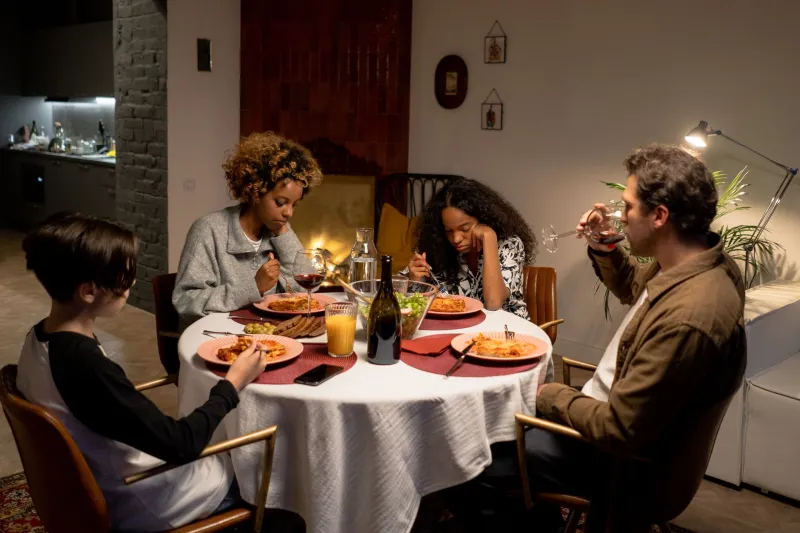
Somewhere around 6:30 on a Tuesday evening in 1978, an American family sat down to eat together. There was no negotiation about whether this would happen. It just happened. Dad was home from work, Mom had cooked something — or vice versa, depending on the household — and the kids came in from wherever they'd been. Everyone sat down. Nobody left until the meal was finished.
What occurred in that hour was unremarkable by the standards of the time and almost impossible to fully recreate today.
The Table Had Rules Nobody Wrote Down
Family dinners in mid-century and late-century America operated on an unspoken social contract. You showed up. You ate what was served. You contributed to the conversation, even if your contribution was mostly eye-rolling. You did not leave the table without permission. And you were present — not as a concept, but physically and mentally present — because there was nothing else competing for your attention.
No screens. No notifications. No alternative world to escape into. The table was the room, and the room was the whole world for that hour.
This forced proximity produced something that sounds almost quaint now: people genuinely learned how to talk to their families. Not just exchange information — talk. About the day, about problems, about opinions, about nothing in particular. Kids learned how adults reasoned through disagreements. Parents got daily, unfiltered glimpses into their children's actual lives. Siblings who genuinely didn't like each other still had to coexist, negotiate, and occasionally find common ground.
It wasn't always pleasant. But it was real.
Getting Everyone to the Table Took Actual Effort
Let's not romanticize the logistics. Coordinating a family dinner in an era before group texts and shared digital calendars was its own kind of project. Parents managed schedules through a combination of standing routines, notes on the refrigerator, and the understanding that certain things — dinner, Sunday church, holiday gatherings — were simply non-negotiable.
Kids had after-school activities, but those activities were structured around the expectation that you'd be home by dinner. Coaches knew it. Teachers knew it. The community understood that the early evening belonged to the family table in a way that social institutions actively protected.
When someone was going to be late, they called — the house phone, which rang in the kitchen, which someone answered. There was no option to send a quick text and stay out another hour. You came home or you didn't, and if you didn't, you explained yourself at the next meal.
The Conversation Was Sometimes Terrible and That Was the Point
Here's something worth saying plainly: a lot of family dinner conversations were awkward, uncomfortable, or flat-out contentious. Fathers who didn't know how to talk to teenage daughters. Siblings relitigating arguments from three days ago. Grandparents saying something that made everyone stare at their plates.
But that friction was doing something. It was teaching everyone at the table how to manage human relationships in real time, without an escape hatch. You couldn't close a tab. You couldn't mute the conversation. You had to sit with the discomfort and eventually work through it, or at least past it.
Psychologists who study family dynamics have long noted that shared meals are one of the strongest predictors of adolescent resilience, academic performance, and emotional health. The research is consistent enough to be almost boring at this point. Kids who eat regularly with their families do better across nearly every measurable dimension.
What the research doesn't fully capture is the mechanism. It's not the food. It's the sustained, distraction-free attention that adults give children during that hour. The message, repeated every evening, that you are important enough for us to stop everything and sit with you.
What Replaced It Isn't Nothing — But It Isn't That
Modern families communicate constantly. More than any generation in history, by pure volume. Group chats, voice memos, reaction emojis, FaceTime calls from the grocery store. Families who live apart are more connected than ever. Families who live together are, in a real sense, always technically available to each other.
And yet something specific has been lost. The dinner table as a mandatory gathering — a daily ritual with weight and structure — has largely dissolved. Meals are eaten at different times, in different rooms, in front of different screens. The family unit still exists, but its daily anchor point has come loose.
You can text your teenager from the next room. You can send a voice message to your spouse while they're driving home. You can be, in every technical sense, constantly in touch. What's harder to replicate is the thing the dinner table used to provide without anyone trying: an hour of undivided, enforced togetherness where the only thing on the agenda was being a family.
A Ritual Worth Reclaiming
Some families are pushing back deliberately — phones in a basket by the door, meals cooked and eaten together, conversations that aren't efficient or goal-oriented. It takes effort now in a way it never used to, because the default has flipped. The path of least resistance is fragmentation.
But the dinner table is still there. The chairs are still there. The only thing missing is the decision to treat that hour as sacred again — not because it was always comfortable, but because the discomfort, it turns out, was part of what made it matter.