Dressed to Last: The Quiet Death of Clothing You Actually Kept
Somewhere in a closet in suburban Ohio, there's probably still a flannel shirt from 1987. It's faded at the collar and soft in a way that only decades of washing can produce. The person who owns it doesn't think of it as vintage. They just think of it as their shirt.
That relationship — between a person and a piece of clothing — used to be completely normal. Now it's almost quaint.
When a New Jacket Was a Decision, Not an Impulse
In the 1970s and 1980s, American families didn't casually drop into a store and walk out with three new tops for $27. Buying clothes was a considered act. You saved. You planned. You went to a department store — a Sears, a JCPenney, maybe a local shop that had been on Main Street since before you were born — and you chose carefully because you knew what you bought was going to be with you for a while.
The average American family spent a meaningful chunk of its household budget on clothing, but they bought far fewer individual items. A winter coat was an investment. A good pair of jeans was something you broke in over a year. Kids wore hand-me-downs not out of poverty, but because the clothes were still perfectly good.
Quality wasn't a marketing buzzword back then. It was just an expectation. Garments were often made domestically or in countries with established manufacturing reputations. Stitching held. Fabric didn't pill after two washes. A blazer purchased in 1979 could reasonably last until 1995 — and often did.
How the Price Tag Fell Through the Floor
The shift started quietly in the late 1980s and accelerated hard through the 1990s. American clothing manufacturers began moving production overseas to take advantage of dramatically lower labor costs — first to Mexico, then to Southeast Asia, then to Bangladesh, Cambodia, and beyond. The savings were passed on to consumers, at least partially, and retail prices began their long, steady decline.
By the early 2000s, a new model had taken hold. Retailers like H&M and Zara — and later, domestic chains chasing the same formula — figured out they could turn trends around in weeks rather than seasons. Design something, manufacture it cheaply, flood the stores, discount what doesn't sell, repeat. The fashion cycle, which once moved twice a year with spring and fall collections, now moved constantly.
The term "fast fashion" entered the cultural vocabulary, but most consumers didn't think of it as a problem. They thought of it as a deal.
Fifty Dollars for a Shirt, or Five — and What You Actually Got
Here's the comparison that tells the story most clearly. In 1980, adjusted for today's dollars, a decent men's dress shirt might cost the equivalent of $60 to $80. It was made with care, from quality cotton, and it was designed to be laundered and worn dozens of times a year for years on end.
Today, you can buy a dress shirt for $14.99. It will look fine on the hanger. It may even look fine the first time you wear it. But the fabric is thinner, the stitching is looser, and after six months of regular washing, it starts to look like it belongs in a donation pile — assuming it makes it that far without a seam giving out.
Consumers didn't exactly choose this trade-off consciously. The market made it for them. When cheap clothing is everywhere, the incentive to care for what you own quietly disappears. Why spend twenty minutes ironing a shirt you paid twelve dollars for?
The Hidden Cost Nobody Talks About
The environmental numbers are genuinely staggering. Americans now throw away roughly 80 pounds of clothing per person every year. The global fashion industry is one of the largest contributors to water pollution on earth. Synthetic fabrics — polyester, nylon, acrylic — shed microplastics every time they're washed, ending up in waterways and eventually in the food supply.
None of this was part of the equation when fast fashion took over. The pitch was simple: more clothes, less money, new trends every few weeks. The externalized costs — environmental, social, and even personal — were never printed on the price tag.
There's also something harder to quantify. When you buy a coat knowing it'll last a decade, you develop a different relationship with it. You notice when a button comes loose and you fix it. You get it cleaned properly. You think about where you're wearing it. That small act of stewardship, repeated across thousands of daily choices, adds up to something — a different way of moving through the world.
The Slow Pushback
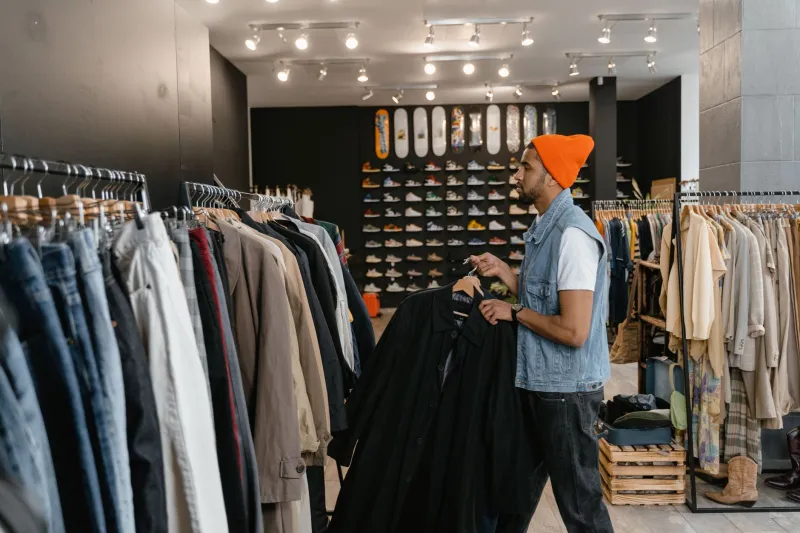
Something interesting has started happening in the last several years. Thrift stores, once the domain of necessity shopping, have become genuinely trendy. Apps like ThredUp and Depop have built entire businesses around secondhand clothing. The word "investment piece" is back in fashion editorial copy, even if it's often used to sell something that isn't quite that.
Younger consumers, particularly those who grew up watching their parents discard and replace without pause, have started asking different questions. Where was this made? How long will it last? Is there a version of this that doesn't fall apart by spring?
It's not a revolution yet. Fast fashion is still enormous, still cheap, still everywhere. But the fact that people are asking those questions at all suggests that something in the cultural memory is stirring — some faint recollection that clothes were once things you kept, not things you cycled through.
Your grandmother's wool coat, the one that still hangs in someone's hall closet, wasn't an accident. It was the product of a different set of assumptions about what things were worth — and how long they were supposed to last.