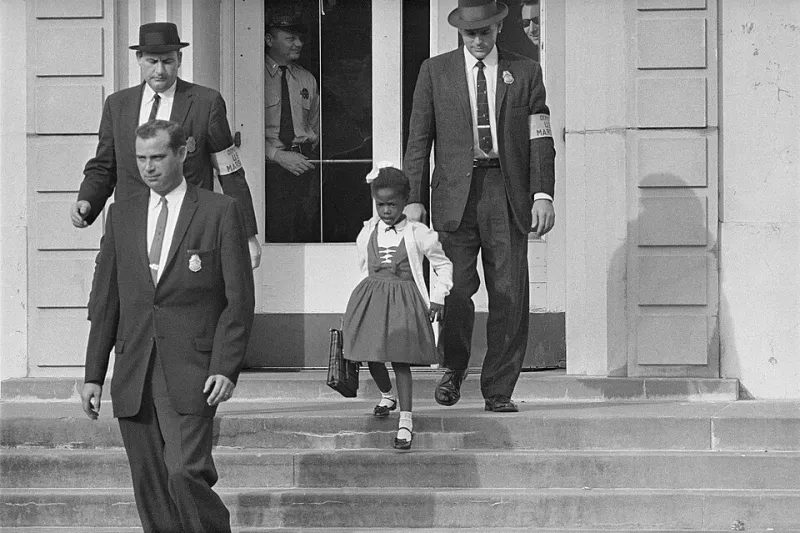
Photo: Uncredited DOJ photographer, restored by Adam Cuerden (a relatively minor restoration), Public domain, via Wikimedia Commons
Somewhere in the back of a school building, in a room most students never saw, sat a filing cabinet. Inside that cabinet were folders. Inside those folders were your grades, your attendance records, maybe a note from a teacher about a rough stretch in third grade. That was the "permanent record" your teachers threatened you with. The one that was supposed to follow you forever.
Here's what nobody told you: it barely followed you anywhere.
The Cabinet Nobody Actually Opened
For most of American public school history, student records were exactly what they sounded like — paper. Hand-typed or handwritten documents stored in manila folders, organized alphabetically, locked behind a door that most students never had reason to approach. The principal's office held your academic fate, technically speaking. But in practice, those folders were rarely opened after you walked out of a school for the last time.
When students transferred schools, a records request would go out. A secretary would pull the folder, photocopy what was needed, and mail it. The process took days, sometimes weeks. It was slow, physical, and — crucially — limited. Only the people who specifically needed your records, and who went through the formal channels to get them, ever saw them.
A bad sophomore year? A failed class you retook? A suspension that was later expunged? Unless someone was actively looking and had a legitimate reason to dig, that information sat in a drawer and aged quietly.
For millions of American students who stumbled — and most students stumble somewhere — that obscurity was a genuine second chance.
What "Permanent" Used to Actually Mean
The irony of the old system is that the so-called permanent record was, in many ways, more forgiving than anything we have today. Yes, the records existed. Yes, they could theoretically be accessed. But the friction involved in accessing them was enormous by modern standards. You had to know what you were looking for, know where to ask, wait for someone to physically locate it, and have a legitimate institutional reason to request it.
That friction was privacy, even if nobody called it that.
College admissions offices received transcripts by mail, reviewed them, and filed them away. They weren't indexed. They weren't searchable. A 2.1 GPA from a rough junior year didn't surface in a Google search. It didn't attach itself to your LinkedIn profile. It didn't follow you into a job interview fifteen years later unless you chose to bring it.
The records were permanent in the sense that they were preserved. They were not permanent in the sense that they were perpetually visible.
The Digital Transcript and the End of Forgetting
Today's students operate in an entirely different reality. Digital transcript systems like Naviance, Parchment, and Common App have streamlined the process of sharing academic records to the point where a complete academic history can be transmitted to dozens of institutions simultaneously with a few clicks. That efficiency is real, and it has genuine benefits — faster processing, fewer lost documents, easier access for students who need their own records.
But it has also fundamentally changed what "on the record" means.
Grades, standardized test scores, attendance patterns, and disciplinary notations now live in systems that are designed to be accessed, shared, and retained. Some states maintain longitudinal student data systems that track academic performance from kindergarten through college. Employers in certain industries can request educational verification reports that surface GPA data and degree information instantly.
And then there's the broader digital footprint that exists alongside the official record — social media posts from high school, forum comments, photos, and public profiles that didn't exist in any form before the internet made teenagers permanently visible to the future.
The Kid Who Failed Chemistry
Think about what this means practically. A student who fails a class, struggles through a difficult year, or makes a serious mistake at sixteen is now navigating consequences that extend well beyond the immediate moment. Not because the rules are harsher, but because the infrastructure of memory is so much more efficient.
In 1985, the kid who failed chemistry junior year, retook it, passed, and went on to study engineering didn't carry that failure into every future conversation. It was in a file. The file stayed in the building. The building eventually closed, and the file was archived or destroyed according to records retention schedules that most people never thought about.
Today, that same student's transcript is a living document. It can be requested, transmitted, and reviewed at any point. The retake shows up. The original grade may show up too, depending on the institution's reporting practices.
What We Traded Without Noticing
None of this is an argument against accurate record-keeping. Accountability matters. Institutions have legitimate reasons to verify academic credentials. The old system had real problems — records got lost, information was inconsistently maintained, and the opacity that protected struggling students sometimes also shielded institutions that weren't serving them well.
But something real was lost in the transition, and it's worth naming it.
The old filing cabinet offered something that no amount of privacy legislation has fully restored: the practical reality of a second chance. Not a second chance on paper, not a formal expungement process requiring a lawyer and a hearing — just the quiet, ordinary second chance that came from information being slow, local, and mostly forgotten.
Students used to be able to outgrow their worst moments. They could leave a school, start over somewhere new, and build an identity that wasn't anchored to a bad year or a poor decision made at fifteen.
That kind of forgetting wasn't a flaw in the system. For a lot of kids, it was the system working exactly as it should.