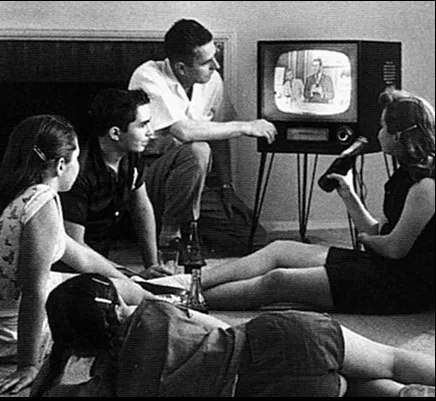
Photo: Evert F. Baumgardner - National Archives and Records Administration., CC0, via Wikimedia Commons
On the night of February 28, 1983, roughly 106 million Americans did the same thing at the same time: they watched the last episode of MAS*H. No streaming, no DVR, no second screen. If you wanted to know why Hawkeye was kissing a horse goodbye, you watched it when it aired or you stayed out of the conversation at work the next morning.
That was normal life for about three decades. And we didn't know it was unusual until we threw it away.
Six Channels and a Schedule
Through the 1960s and '70s, most American households had a handful of choices: ABC, CBS, NBC, maybe a PBS affiliate, maybe an independent UHF station playing reruns. The TV Guide was the closest thing to a menu, and dinner was served at the network's discretion. Want the western? It's Thursday at 9. Miss it? Maybe it comes back in the summer reruns.
That scarcity sounds like a limitation, and it was. But it did something strange and wonderful: it manufactured common ground. The water-cooler conversation wasn't a metaphor — it was a national institution. Monday morning, tens of millions of people had seen the same episode of Ed Sullivan or the same World Series game, and they talked about it because there was literally nothing else to talk about.
Even the commercials were shared property. Ask anyone over 50 to finish the phrase "two all-beef patties, special sauce..." and watch them do it without hesitation.
The Remote Control as a Gateway Drug
The first crack in the shared-culture wall wasn't streaming. It was the remote control, then cable, then the VCR. Suddenly a household could watch this while another one watched that. By the 1990s, a hundred-channel universe meant the water cooler had already started to splinter — the guy in accounting watched ESPN, the woman in HR watched Lifetime, and finding common ground took actual effort.
Then came the flood. Netflix, Hulu, YouTube, TikTok. Today the average American has access to a catalog of tens of millions of hours of content, available instantly, on a screen in their pocket.
We won. We got everything we wanted.
The Scroll Is the New Nothing On
And yet. The average streaming subscriber now spends something like seven minutes browsing for every thirty minutes actually watching. We've all felt it: forty-five minutes of scrolling three services, landing on a rerun of a show we've already seen, feeling vaguely defeated.
Here's the paradox nobody predicted: choice didn't eliminate the frustration of having nothing to watch — it industrialized it. In 1975, the decision was made for you by three programming executives in New York. In 2025, it's made by you, every night, from an infinite menu, which turns out to be its own kind of exhaustion.
What We Gave Up Without Noticing
The real cost wasn't the scrolling. It was the disappearance of the shared moment.
The MAS*H finale's 106 million viewers is a number that may never be approached again by anything that isn't a Super Bowl — and even the Super Bowl's audience, once a guaranteed national lock, is increasingly a choice among viewing options. When Game of Thrones was at its peak, it was hailed as "the last water-cooler show," and that framing told the whole story: we knew we were watching something become extinct.
Now culture happens in bubbles. Your coworker has never seen the show you binged last weekend. Your group chat argues about a creator you've never heard of. The monoculture had real costs — it excluded voices, it flattened taste, it made three executives in a boardroom the gatekeepers of what America talked about. Nobody's nostalgic for gatekeeping.
But the trade was real. We exchanged a small menu everyone shared for an infinite menu no one does. We gained the freedom to watch exactly what we want, whenever we want — and lost the odd, accidental intimacy of knowing that on a Tuesday night in 1983, a hundred million strangers were laughing at the same joke at the same moment.
The six-channel era wasn't better. It was just smaller. And sometimes, without meaning to, we discover that small was doing something for us.