The Sunday Morning Job Hunt: When Finding Work Meant Racing to the Newsstand
The Weekly Lottery That Determined Your Career
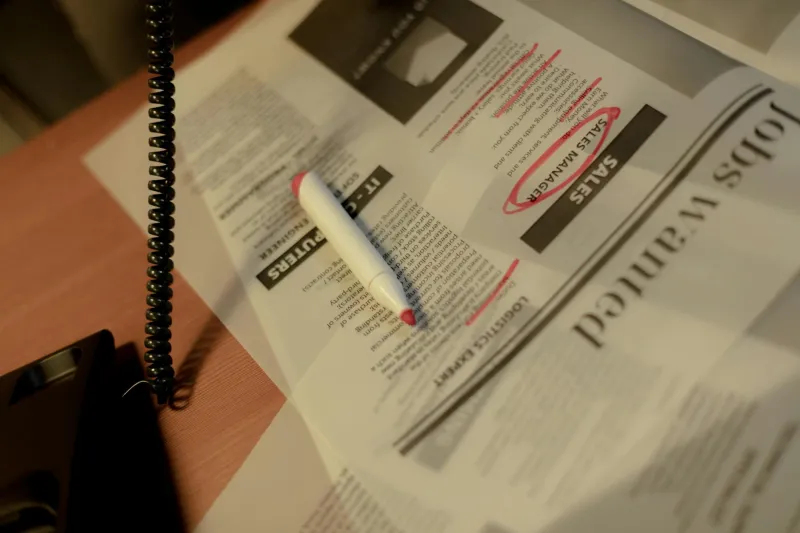
Every Sunday morning across America, millions of people performed the same ritual. They'd drive to the corner store, buy the thickest newspaper they could find, and flip immediately to the classified section. Armed with a red pen and a cup of coffee, they'd spend the next hour circling tiny, cryptic advertisements that might—might—lead to their next job.
"ADMIN ASST needed. Exp req'd. Send resume to Box 247."
"SALES REP - Growing company seeks motivated individual. Good benefits. Call Mon-Fri 9-5."
These weren't job descriptions—they were puzzles. You'd spend 15 minutes trying to decode whether "growing company" meant "exciting startup" or "desperate employer with high turnover." The phrase "competitive salary" could mean anything from $20,000 to $60,000, and you'd never know until you were sitting across from a hiring manager weeks later.
This was job hunting in America before the internet, and it was as much about luck and timing as it was about qualifications.
The Typewriter Test of Your Professional Future
Once you'd circled your targets in the classifieds, the real work began. Each application was a custom production that could take hours to complete properly. You'd need to type a cover letter on actual paper using an actual typewriter, where every mistake meant starting over from scratch.
The cover letter had to be perfect—not just in content, but in presentation. Employers expected crisp, professional typing with no correction fluid visible. If you made a typo on the second page, you retyped the entire letter. Many people kept carbon paper to make copies, because photocopying was expensive and often produced results that looked unprofessional.
Then came the resume, which also had to be typed fresh for each application if you wanted to customize it for the specific role. The idea of having 15 different versions of your resume saved on a computer and being able to modify them instantly was pure science fiction. You had one master resume, and if you wanted to emphasize different experience for different jobs, you were retyping the whole thing.
The Black Hole of Corporate America
After you'd spent hours crafting the perfect application, you'd mail it to a company you knew virtually nothing about. There was no company website to research their culture, no Glassdoor reviews to warn you about toxic management, no LinkedIn profiles to scope out your potential colleagues.
You were essentially throwing your resume into a black hole and hoping someone on the other side would find it interesting enough to call you back. And "calling you back" meant they had to reach you at home during business hours, or leave a message on your answering machine that you might not get until evening.
The waiting was excruciating. Most companies didn't even send rejection letters, so silence could mean either "we're still considering you" or "we threw your resume away three weeks ago." People would wait by their phones for weeks, afraid to leave the house for too long in case they missed The Call.
The Research That Required a Private Investigator
Want to know what a company actually did before you interviewed? Good luck. You might find a brief mention in the Yellow Pages, or if you were really lucky, a paragraph in a business directory at the library. Some job seekers would actually drive by the company's office building to see if it looked legitimate and successful.
Salary information was completely opaque. Websites like PayScale and Salary.com didn't exist, so you had no idea what you should be asking for. You'd go into salary negotiations completely blind, often accepting offers that were significantly below market rate simply because you had no way to know what market rate actually was.
Networking meant literally networking—calling people you knew, asking if they knew anyone at companies you were interested in, and hoping someone would agree to put in a good word for you. The idea of reaching out to strangers on a professional social network would have seemed bizarre and probably inappropriate.
The Interview That Required Faith
When you finally got an interview, you'd show up knowing almost nothing about the people you were meeting with or the specific challenges the role was meant to address. You couldn't look up your interviewer's background, see what projects the company was working on, or even verify that the job posting was legitimate.
This led to some spectacularly mismatched interviews. People would spend hours preparing for what they thought was a marketing position, only to discover it was actually telemarketing. Others would interview for "administrative assistant" roles that turned out to be receptionist positions with no possibility for advancement.
The power dynamic was completely skewed toward employers. They had all the information, and you had whatever you could glean from a three-line classified ad and a 20-minute conversation.
The Revolution That Started With Monster.com
The first online job boards in the late 1990s seemed like minor conveniences rather than revolutionary changes. Instead of buying a newspaper, you could browse job listings on a computer. Instead of typing cover letters, you could copy and paste.
But the real transformation came gradually, as both the volume of information and the speed of communication exploded. Suddenly, you could apply to dozens of jobs in the time it used to take to apply to one. You could research companies extensively before ever contacting them. You could see salary ranges, read employee reviews, and even connect with current employees to ask about company culture.
The Job Hunt That Never Ends
Today, the average job seeker might apply to 100+ positions before finding the right fit. This would have been literally impossible under the old system—the time and money required to produce 100 custom cover letters and mail 100 resumes would have been prohibitive for most people.
Modern job hunting happens in real-time. You can apply to a job from your phone while waiting for coffee, get an automated response confirming your application within minutes, and sometimes hear back from a recruiter the same day. The entire cycle that used to take weeks now happens in hours.
LinkedIn has made networking scalable in ways that would have seemed magical to previous generations. You can identify employees at target companies, reach out to them directly, and often get insider information about roles before they're even posted publicly.
The Sunday Ritual We Don't Miss
Ask anyone who job-hunted in the pre-internet era about their Sunday morning routine, and you'll hear stories of desperation and frustration that younger workers can barely imagine. Racing to the newsstand to get the paper before all the good jobs were "taken." Calling numbers that were busy for hours because dozens of other people were trying to reach the same employer. Mailing resumes into the void and never hearing anything back.
The inefficiency was staggering. Qualified candidates couldn't find employers who needed their skills, and employers couldn't find the talent they needed, all because the information systems connecting them were so primitive.
We've gained so much in the transition to digital job hunting that we've forgotten what we've lost: the simplicity of a world where job searching was a discrete activity that happened on Sunday mornings, rather than a continuous background process that never really ends. But given the choice between the Sunday paper lottery and the instant, information-rich job market we have today, very few people would choose to go back to racing to the newsstand with a red pen and a prayer.