The Paper Map Era: When Road Trips Required Navigation Skills Nobody Teaches Anymore
The Paper Map Era: When Road Trips Required Navigation Skills Nobody Teaches Anymore
There's a moment in every older person's travel story—the moment they admit they took a wrong turn and ended up 40 miles outside of town, or the time they missed an exit entirely and didn't realize it until they'd driven another hour. These weren't cautionary tales. They were just what happened sometimes. Getting lost was a normal, expected part of any road trip that took you beyond familiar territory.
Now, it's almost impossible to get lost.
Before the Blue Dot
In the 1980s and 1990s, driving to an unfamiliar destination required preparation that most modern travelers would find exhausting. The process looked something like this:
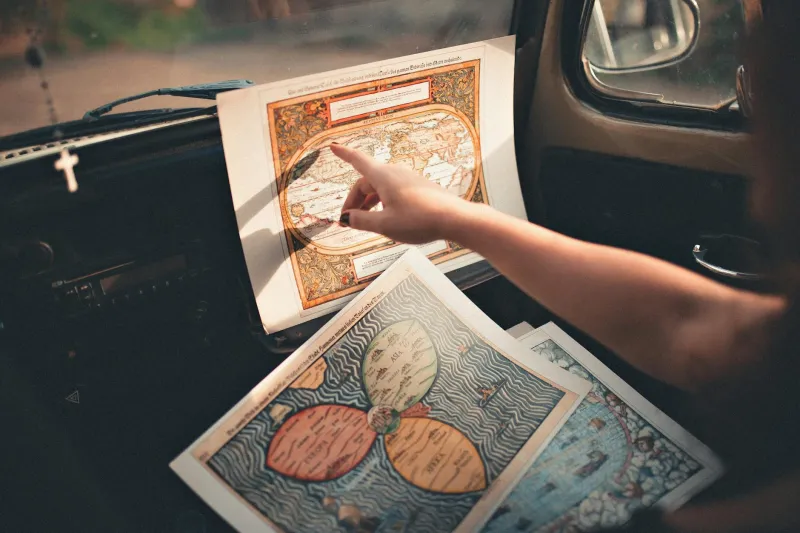
You'd get out a paper map—usually from a gas station, or maybe an atlas you kept in the car. You'd locate your starting point. You'd locate your destination. Then you'd trace the route with your finger, trying to memorize the sequence of turns, exits, and highway numbers.
If you were serious, you'd write down turn-by-turn directions on a piece of paper. "Take I-40 East for 47 miles. Exit at Highway 17 North. Turn left on Maple Street. Destination on right."
Then you'd drive.
The paper map stayed on the passenger seat or dashboard, theoretically available for reference. In practice, reading a map while driving was difficult, dangerous, and often impossible. If you were on a highway, you couldn't safely pull it out and study it. If you were in a city, navigating traffic while also consulting a map required a level of coordination that made the experience genuinely stressful.
So most people didn't really use the map while driving. They relied on the directions they'd memorized or written down. And when they didn't remember the next turn, or when they missed an exit, or when construction blocked their planned route—they were genuinely lost.
The Gas Station Question
When lost, there was only one real option: stop and ask for directions.
This was awkward. It required admitting defeat. It required approaching a stranger—usually at a gas station—and explaining where you were trying to go. The stranger would then try to give you verbal directions, often with hand gestures, often assuming you knew local landmarks you'd never heard of.
"You know where the old Walmart was? The one that burned down?"
"No."
"Okay, well, you're gonna go past that, and then you'll see a Denny's..."
These directions were frequently wrong. People's sense of distance is notoriously unreliable. They'd say "it's just five minutes away" when they meant 20 minutes. They'd forget about a major turn. They'd describe the route in a way that only made sense if you'd lived in the area for years.
So you'd drive off with your written-down version of someone's spoken directions, and half the time, you'd end up lost again.
Navigation as a Skill
This meant that good navigators—people who had a natural sense of direction, who could read maps quickly, who could mentally rotate a map to match the actual landscape around them—had a genuine advantage. They were the people you wanted in the passenger seat. They were the people who could get you somewhere without getting lost.
Some people could look at a map for 30 seconds and have a complete mental picture of the route. Others would study a map for five minutes and still get confused by the symbols and the angles.
Being a good navigator required:
- Spatial reasoning (the ability to visualize 3D space from a 2D representation)
- Attention to detail (remembering that you were supposed to turn at the third light, not the second)
- Comfort with uncertainty (accepting that you might take a wrong turn and having to correct course)
- Patience (not panicking when you realized you'd made a mistake)
Families would divide labor: one person was the driver, one person was the navigator. The navigator had real responsibility. If the driver got lost, it was often because the navigator had misread the map or given incomplete directions.
The Complete Elimination of Uncertainty
GPS changed everything, and it changed it completely.
The first consumer GPS devices appeared in the 1990s, but they were expensive, bulky, and unreliable. A real transformation happened after 2007, when the iPhone was released with GPS capability. By the 2010s, smartphone maps were accurate, fast, and constantly updating based on real traffic data.
Now, getting lost requires genuine incompetence. You'd have to ignore the phone's directions entirely, or drive with the phone turned off, or actively disbelieve the map's guidance. The blue dot on the screen shows exactly where you are. The app recalculates instantly if you take a wrong turn. It tells you which lane to be in, how far the next turn is, and what to expect when you get there.
You can't really get lost anymore. Not unless you want to.
What the Road Trip Used to Feel Like
This might sound like pure progress, and in terms of efficiency, it is. You get where you're going faster. You don't waste time driving in circles. You don't have the stress of uncertainty.
But something changed about the experience of travel itself.
When getting lost was possible—even likely—road trips felt like genuine adventures. You were going somewhere unfamiliar, and there was a real element of uncertainty. You might discover a restaurant you'd never heard of because you took a wrong turn. You might see parts of a city you never would have seen if you'd stayed on the planned route. You might have a story: "We got completely lost, but we ended up finding this amazing diner..."
You were also more present. You had to pay attention. You had to look at street signs. You had to remember directions. You had to actively navigate rather than passively following a voice.
Most importantly, you had agency. If you got lost, it was your responsibility. You had to figure it out. You had to decide whether to ask for help or keep trying. You had to trust your own judgment.
The Quiet Loss
None of this is to say we should go back to paper maps. GPS is genuinely better in almost every practical way. Road trips are faster, safer, and less stressful.
But the complete elimination of navigation uncertainty has reshaped how we experience travel. We don't really explore anymore—we follow directions to predetermined destinations. We don't have to develop spatial reasoning or navigation skills. We don't have those adventure stories that come from getting lost and finding your way.
We've optimized the road trip. We've also made it slightly less human.
Most people under 30 have never driven to an unfamiliar city without GPS. They've never had to ask for directions. They've never experienced that moment of genuine uncertainty on a highway, trying to figure out if they were going the right direction.
They've never gotten truly lost.
And they'll never know what they're missing—because the possibility of getting lost is almost gone.