The Last Generation Who Knew How to Be Truly Lost
The Art of Getting Beautifully Lost
There was a particular type of panic that belonged exclusively to the pre-GPS era: that sinking feeling when you realized you'd been driving for an hour in the wrong direction, with no cell phone to call for help and no digital assistant to recalculate your route. Yet for all its frustration, being lost was also one of the last remaining adventures in American life—a genuine unknown in an increasingly mapped and measured world.
Getting lost wasn't just a navigation failure; it was a rite of passage that taught spatial reasoning, problem-solving, and the peculiar intimacy that comes from truly not knowing where you are. It forced you to pay attention to your surroundings in ways that modern travelers simply don't need to anymore.
When Directions Were Folk Art
Before GPS, getting somewhere new meant collecting directions like pieces of folk art, each person adding their own flourishes and landmarks. "Take Route 9 until you see the old red barn—not the new red barn, mind you, the old one with the Coca-Cola sign—then turn left at the gas station that used to be a Texaco but now it's something else."
These hand-drawn maps and verbal directions weren't just functional; they were cultural artifacts that revealed how people understood their landscape. Directions were given in terms of local knowledge: the church where the Hendersons got married, the intersection where that bad accident happened three years ago, the hill where you can see the water tower from two towns over.
The Ritual of Preparation
Planning a road trip in the 1980s was an elaborate ritual that began weeks before departure. You'd visit AAA to get TripTiks—those spiral-bound booklets with highlighted routes and local points of interest. You'd study road atlases, memorizing major highway numbers and trying to understand the relationship between different cities.
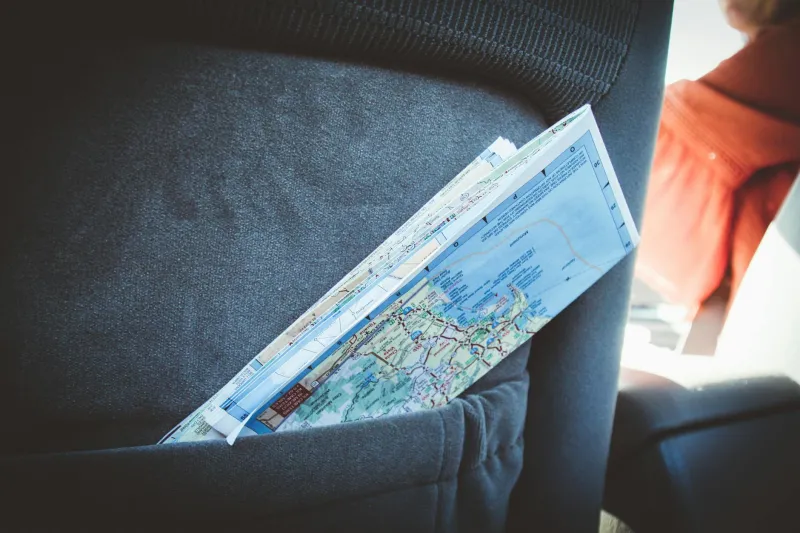
The glove compartment became a navigation center stocked with folded maps for different regions, each one a testament to previous adventures and wrong turns. Those creases in the paper told stories: the vacation where you got lost in the Appalachian mountains, the business trip where you accidentally discovered that perfect barbecue joint in rural Kansas.
The Skills We Developed Without Knowing It
Navigating without GPS required a suite of cognitive skills that modern travelers never develop. You learned to maintain a mental map of your location relative to major landmarks and cardinal directions. You developed an intuitive sense of distance and time, understanding that thirty miles in Montana felt different from thirty miles in Connecticut.
Most importantly, you learned to read landscapes. The way mountains sat on the horizon, the angle of afternoon sunlight, the types of license plates in parking lots—all became clues about where you were and which direction you needed to go. Getting lost taught you to be observant in ways that following a blue dot simply doesn't require.
The Democracy of Local Knowledge
Before smartphones, local knowledge was genuinely valuable. The gas station attendant who could direct you to the best route around construction, the diner waitress who knew which back roads were scenic, the hotel desk clerk who could recommend a shortcut—these people possessed information you literally couldn't get anywhere else.
This created a different relationship between travelers and locals. You had to interact with people, ask questions, and rely on the kindness of strangers in ways that modern GPS navigation has made largely unnecessary. Every road trip involved dozens of small human interactions that don't happen anymore.
The Serendipity of Wrong Turns
Getting lost was often how Americans discovered their most treasured places. That antique shop you stumbled across while looking for the interstate, the scenic overlook you found while trying to get back on track, the small town diner where you stopped to ask for directions and ended up staying for the best pie of your life—these experiences were the byproducts of navigational uncertainty.
Modern GPS navigation is ruthlessly efficient, routing you along the fastest possible path and eliminating the possibility of accidental discovery. We've gained efficiency but lost serendipity, trading the possibility of unexpected adventure for the certainty of arriving on time.
The Anxiety and the Freedom
Being lost created a unique form of low-level anxiety that shaped how people traveled. You'd leave earlier to account for potential wrong turns, carry more cash for unexpected stops, and maintain a heightened awareness of your surroundings. But this anxiety was paired with genuine freedom—the knowledge that you might end up somewhere completely different from where you intended to go.
There was something liberating about accepting that getting lost was part of the journey. It forced you to be present in the moment, to pay attention to your immediate surroundings rather than fixating on your destination. The journey itself mattered more when you weren't entirely sure where it was leading.
What the Blue Dot Stole From Us
GPS navigation didn't just change how we get places; it fundamentally altered our relationship with geography and discovery. Modern travelers move through landscapes without really seeing them, following digital breadcrumbs rather than developing their own understanding of place and direction.
We've lost the ability to be genuinely surprised by our surroundings. Every restaurant, every attraction, every scenic overlook has been catalogued and rated online. The possibility of stumbling across something truly unexpected has been largely eliminated by our collective digital omniscience.
The Last Explorers
The generation that navigated by paper maps and dead reckoning were the last true explorers of the American landscape. Not because they were discovering uncharted territory, but because they were discovering it personally, building their own mental maps through trial and error, wrong turns and happy accidents.
Younger travelers today will never experience the particular satisfaction of finding your way without digital assistance, or the strange intimacy that comes from being completely disoriented in an unfamiliar place. They'll never know the joy of successfully navigating by landmarks and intuition, or the stories that come from getting spectacularly lost and finding your way home again.
The End of an Era
When we gained GPS, we lost more than just the ability to get lost—we lost a fundamental human experience that had existed for as long as people had traveled beyond their immediate neighborhoods. The skills, the stories, the serendipitous discoveries, and the deep satisfaction of finding your own way through an uncertain world have all been replaced by the passive experience of following a blue dot on a screen.
It's progress, undoubtedly. But it's also the end of a chapter in American culture, when getting lost was still possible and finding your way was still an adventure.