The Grocery Store Checkout That Required a PhD in Patience
The Checkout Line Time Warp
Today, you can buy a week's worth of groceries and pay for them faster than it takes to bag the items. Tap your phone, watch the payment process instantly, grab your receipt, and you're done. But travel back to the 1980s, and that same transaction could consume more time than it took to actually shop for the food.
The grocery checkout wasn't just a place to pay—it was a theater of human patience where time moved differently and every payment method came with its own elaborate ritual.
The Cash Calculation Ceremony
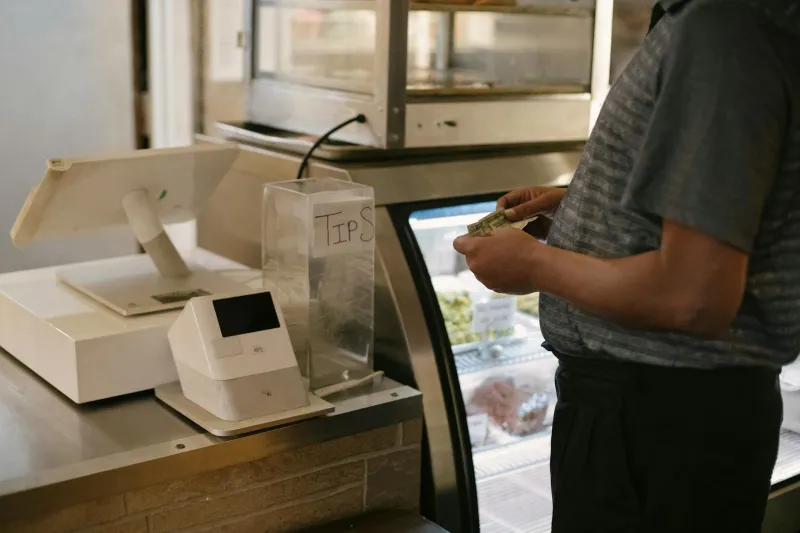
Cash was king, but paying with cash was anything but simple. When your total came to $47.23, you'd start the mental gymnastics: Do I have exact change? Should I break a fifty? Can I find three pennies in my purse to avoid getting seven cents back?
Customers would dig through wallets, count coins, and perform complex calculations to minimize the change they'd receive. The checkout process often resembled a math test administered under pressure, with a line of increasingly impatient shoppers serving as your audience.
Cashiers were human calculators who could make change in their heads faster than most people could find their wallet. They'd count bills back to you: "$47.23 out of fifty, that's $2.77 back—two singles and three quarters, a penny, and a penny makes $2.77." This verbal accounting served as both confirmation and education, ensuring everyone understood the transaction.
Some stores offered "cash back" from checks, but getting extra cash with your groceries required additional paperwork and manager approval. The simple concept of getting money from a grocery store—now standard with debit cards—was a complex privilege reserved for established customers with checking accounts.
The Personal Check Production
Writing a check for groceries was a performance art that required preparation, documentation, and faith in the banking system. First, you'd need to find your checkbook, which might be buried in a purse or wallet alongside other financial artifacts.
The check-writing process began before you even picked up the pen. You'd need two forms of identification—usually a driver's license and a credit card—which the cashier would examine with the intensity of a border guard. Some stores maintained "check approval" lists, consulting thick binders of approved customers before accepting your payment.
Writing the check itself was a careful process. You'd fill in the store name, write out the amount in both numbers and words ("Forty-seven and 23/100 dollars"), sign your name, and hand it over for inspection. The cashier would compare your signature to your ID, stamp the check with the store's endorsement, and sometimes call a manager for amounts over a certain threshold.
The whole process could take five minutes for a single transaction, during which everyone behind you in line would shift their weight, check their watches, and contemplate the life choices that led them to this particular checkout lane at this particular moment.
The Credit Card Ritual
Early credit cards required a process so complex it feels almost medieval by today's standards. The cashier would take your card, place it in a manual imprinter (the "knuckle buster"), lay a multi-part carbon paper form over it, and slide a heavy bar across to create an impression of your raised card numbers.
This carbon copy system created multiple copies—one for you, one for the store, one for the bank—in a single manual operation that required actual physical strength. The distinctive "ka-chunk" sound of the credit card imprinter was the soundtrack of 1980s commerce.
For larger purchases, stores would call the credit card company to verify the transaction. The cashier would dial a phone number, provide your card details, and wait for verbal authorization. This could take several minutes, during which you'd stand there hoping your credit limit could handle a $73 grocery bill.
You'd sign the carbon copy receipt, the cashier would compare your signature to the one on the back of your card, and you'd receive your yellow copy as proof of purchase. The whole process generated enough paper to stock a small office supply store.
The Magnetic Stripe Revolution
When magnetic stripe card readers arrived in the late 1980s and early 1990s, they seemed like science fiction. You could swipe your card through a slot, and the machine would instantly read your account information. No more carbon paper, no more phone calls, no more manual imprinting.
But even swiping had its learning curve. Cards had to be swiped at the right speed, in the right direction, with the magnetic stripe oriented correctly. "Please swipe again" became the most common phrase at checkout counters, as customers learned the precise technique required to make the technology work.
PIN numbers added another layer of complexity. You'd swipe your card, then carefully enter your four-digit code on a keypad, shielding your hand from potential observers like you were entering nuclear launch codes. The machine would process for several seconds—an eternity compared to today's instant approvals—before displaying "APPROVED" or the dreaded "DECLINED."
The Debit Card Game-Changer
Debit cards eliminated the need for cash or checks while providing immediate access to your bank account. But early debit systems were slow and unreliable. You'd swipe, enter your PIN, and wait while the machine connected to your bank's computer system over phone lines that seemed designed for maximum suspense.
The processing time gave you plenty of opportunity to second-guess your account balance. Did that paycheck clear? Was there enough money to cover this purchase? The few seconds between entering your PIN and receiving approval felt like a credit check for your entire financial life.
"Cash back" with debit cards revolutionized access to money. Suddenly, you could get cash at grocery stores, gas stations, and pharmacies without finding an ATM. This convenience came with limits—usually $40 or $50—but it transformed everyday retail locations into mini-banks.
The Contactless Future
Today's payment methods would have seemed like pure magic to 1980s shoppers. Tap your phone or card against a reader, and the transaction completes in under two seconds. No signatures, no PINs for small purchases, no waiting for approval.
Mobile payment apps like Apple Pay and Google Pay have eliminated even the need to carry physical cards. Your phone contains all your payment methods, secured by fingerprints or facial recognition that's more sophisticated than the ID checks that used to be required for writing a check.
The speed is almost surreal. You can complete a grocery transaction faster than it used to take just to find your wallet. The payment happens so quickly that stores have had to install screens showing "Payment Successful" because customers couldn't believe the transaction was actually complete.
The Friction We've Forgotten
All that old payment friction served purposes we've mostly forgotten. Writing checks required you to track your spending in a register, creating a built-in budgeting system. Counting cash made you physically aware of how much you were spending. Even the delay of credit card authorization gave you a moment to reconsider large purchases.
Today's frictionless payments are undeniably more convenient, but they've also made it easier to spend money without thinking about it. The psychological barrier of handing over physical cash or writing out a check amount in words has been replaced by the effortless tap of a screen.
The social aspect of payment has also disappeared. Cashiers no longer need to examine your ID, verify your signature, or engage in the small talk that naturally occurred during longer transactions. The human interaction that was built into the old payment systems has been optimized away in favor of speed and efficiency.
What We Gained and Lost
Modern payment systems have given us speed, convenience, and security that would have been impossible to imagine during the check-writing era. We can buy groceries, pay bills, and transfer money with a few taps on our phones, eliminating the paperwork, waiting, and complexity that used to define financial transactions.
But we've also lost the natural pace that forced us to be more deliberate about our purchases. The friction that slowed down transactions also slowed down spending decisions. When paying for groceries required effort and attention, we were more conscious of what we were buying and what it cost.
The cashiers who could make change in their heads and recognize regular customers by their preferred payment method have been replaced by self-checkout systems that assume we can figure everything out ourselves. We've traded human expertise for automated efficiency.
The Invisible Revolution
Perhaps the most remarkable thing about this transformation is how invisible it's become. Payment technology has advanced so dramatically that we barely notice it anymore. The complex, time-consuming rituals that once defined every purchase have been replaced by systems so seamless they feel like magic.
Younger shoppers who've never written a check or waited for credit card approval can't fully appreciate the miracle of instant payment. To them, tapping a phone to buy groceries is as natural as breathing—they've inherited a world where commerce moves at the speed of thought.
The next time you tap your phone to pay for groceries and walk out of the store in seconds, remember the generations of shoppers who stood in checkout lines, counting change, writing checks, and waiting for approval. They navigated a world where every purchase was a small adventure in patience, precision, and financial choreography.