Summer in an American City Once Meant Weeks of Dangerous Heat and Nowhere to Hide
Summer in an American City Once Meant Weeks of Dangerous Heat and Nowhere to Hide
Somewhere in your home right now, there's a machine you almost certainly take for granted. It hums quietly in the background, keeping the air at a temperature your body finds comfortable, and you have likely never once stopped to feel grateful for it. The air conditioner is one of the most transformative technologies in American history — and also one of the most invisible, precisely because it works so well that it erased the problem it solved.
To understand what it replaced, you have to try to imagine summer in an American city before it existed. Not inconvenient summer. Not "the AC isn't keeping up" summer. Summer as an unmanaged, potentially lethal force that shaped how people lived, where they slept, and in some cases, whether they survived.
The Heat That Killed
The summer of 1896 sent a brutal heat wave across the Eastern Seaboard. In New York City alone, approximately 1,300 people died over the course of ten days. Horses collapsed in the streets. Tenement residents — packed into buildings with poor ventilation, no running water in many units, and no way to cool down — simply succumbed. The city's morgues couldn't keep up.
This was not an isolated tragedy. Deadly heat events were a recurring feature of American urban life throughout the late 19th and early 20th centuries. The summer of 1936, during the Dust Bowl era, killed an estimated 5,000 Americans across the Midwest and Great Plains. Cities like St. Louis, Kansas City, and Chicago recorded temperatures above 100°F for days at a stretch, with no relief after dark because the brick and concrete of urban neighborhoods absorbed heat during the day and radiated it back through the night.
For working-class and poor city residents, there was simply no escape. Wealthy families could retreat to summer homes in the mountains or on the coast. Everyone else stayed and endured.
Life Adapted Around the Heat
Before air conditioning, American cities didn't just suffer through summer — they reorganized around it. Entire behavioral and architectural patterns developed specifically to manage heat in an era when heat was unmanageable.
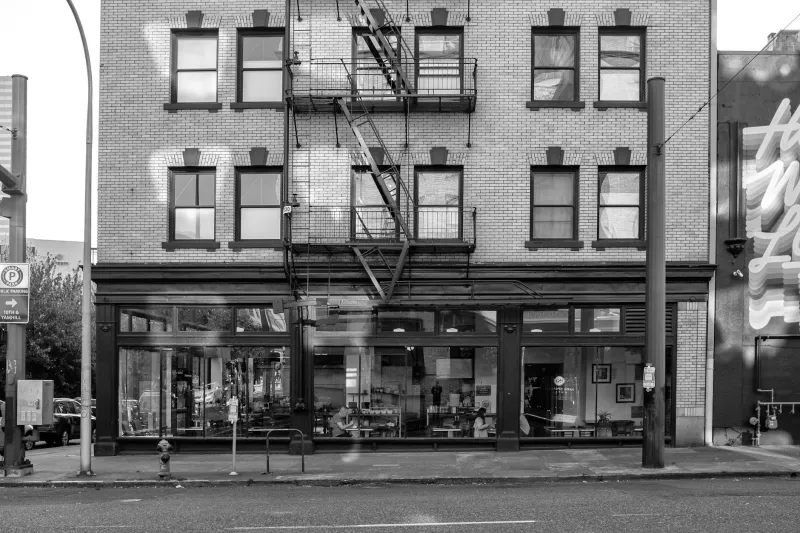
People slept on fire escapes. They dragged mattresses to rooftops. Families in cities like New York and Washington DC would relocate their entire sleeping situation to the coolest spot they could find, which was often several floors above street level where at least a breeze might exist. City parks became overnight refuges — photographs from the early 20th century show Central Park covered in sleeping New Yorkers on particularly brutal nights, a scene that looks more like a refugee camp than a leisure space.
Architects designed for airflow in ways that modern construction rarely needs to consider. Thick walls, high ceilings, wide porches, and cross-ventilation were not aesthetic choices — they were survival strategies. The deep-set windows of Southern architecture, the dogtrot houses of rural America, the transom windows above interior doors in old urban row houses: all of these features were engineering solutions to a problem we've since solved with electricity and refrigerant.
Workplaces adapted too. Courts in Washington DC regularly suspended sessions during extreme heat. Factories saw productivity collapse. The federal government occasionally operated on shortened summer schedules. Heat wasn't just a personal inconvenience — it was a structural force that bent institutions around it.
The Machine That Changed Everything
Willis Carrier invented the first modern air conditioning system in 1902, but it was designed for industrial use — controlling humidity in a Brooklyn printing plant. The technology spent decades confined to factories, movie theaters, and department stores before it began entering American homes in significant numbers.
Movie theaters were the first places many ordinary Americans experienced mechanical cooling, and the industry was not shy about exploiting it. "It's Cool Inside" became a marketing phrase that drove summer attendance. People went to the movies in the 1930s and 40s not just for the film but for the cold air — a luxury that existed nowhere else in their daily lives.
Home air conditioning expanded rapidly after World War II. Window units became affordable for middle-class families through the 1950s and 60s. Central air became a standard feature of new construction across the Sun Belt. And with that shift came a migration that reshaped the country's political and demographic map.
The Political Geography of Cool Air
Before air conditioning, the American South and Southwest were not particularly attractive places to live in large numbers. Summers in Phoenix, Houston, Miami, and Atlanta were genuinely brutal — hot enough to limit population growth and economic development. The Sun Belt boom that transformed American politics from the 1960s onward was not just a story of economic opportunity and cheap land. It was a story made possible by the air conditioner.
Without mechanical cooling, Las Vegas is a small desert outpost. Phoenix doesn't grow past a modest regional city. Houston doesn't become an energy capital. The population shift of the late 20th century — which moved political power toward the South and West and reshaped the Electoral College — was enabled, in part, by a technology that made previously hostile climates livable on a mass scale.
The Thing You've Never Thought to Appreciate
Today, about 90 percent of American homes have air conditioning. On a hot July afternoon, you walk from your cooled home to your cooled car to your cooled office without experiencing more than a few seconds of outdoor heat. The summers that killed thousands of people in New York's tenements, that drove families to sleep on rooftops, that bent the operations of governments and courts — those summers still exist outside your window. You just don't have to live inside them anymore.
The air conditioner didn't just make summer more comfortable. It changed where Americans live, how cities are built, what buildings look like, and how political power is distributed across the country. It is, quietly, one of the most consequential machines in the history of American life.
And it's probably something you've complained about for being too loud.